Cart abandonment is rarely one thing going wrong; it is a checkout flow leaking in five different places, and each leak needs its own fix. A customer who fills a cart has already chosen the product. Something between that choice and the payment screen stopped them, and what stopped them decides whether a message can help at all.
How this guide is built: it maps the five leaks in order, names which three a message can close, and says plainly which two it cannot. Message categories, the opt-in requirement and the 24-hour window come from Meta’s WhatsApp Business Platform documentation, read on 25 September 2026.
Where does a checkout actually leak?
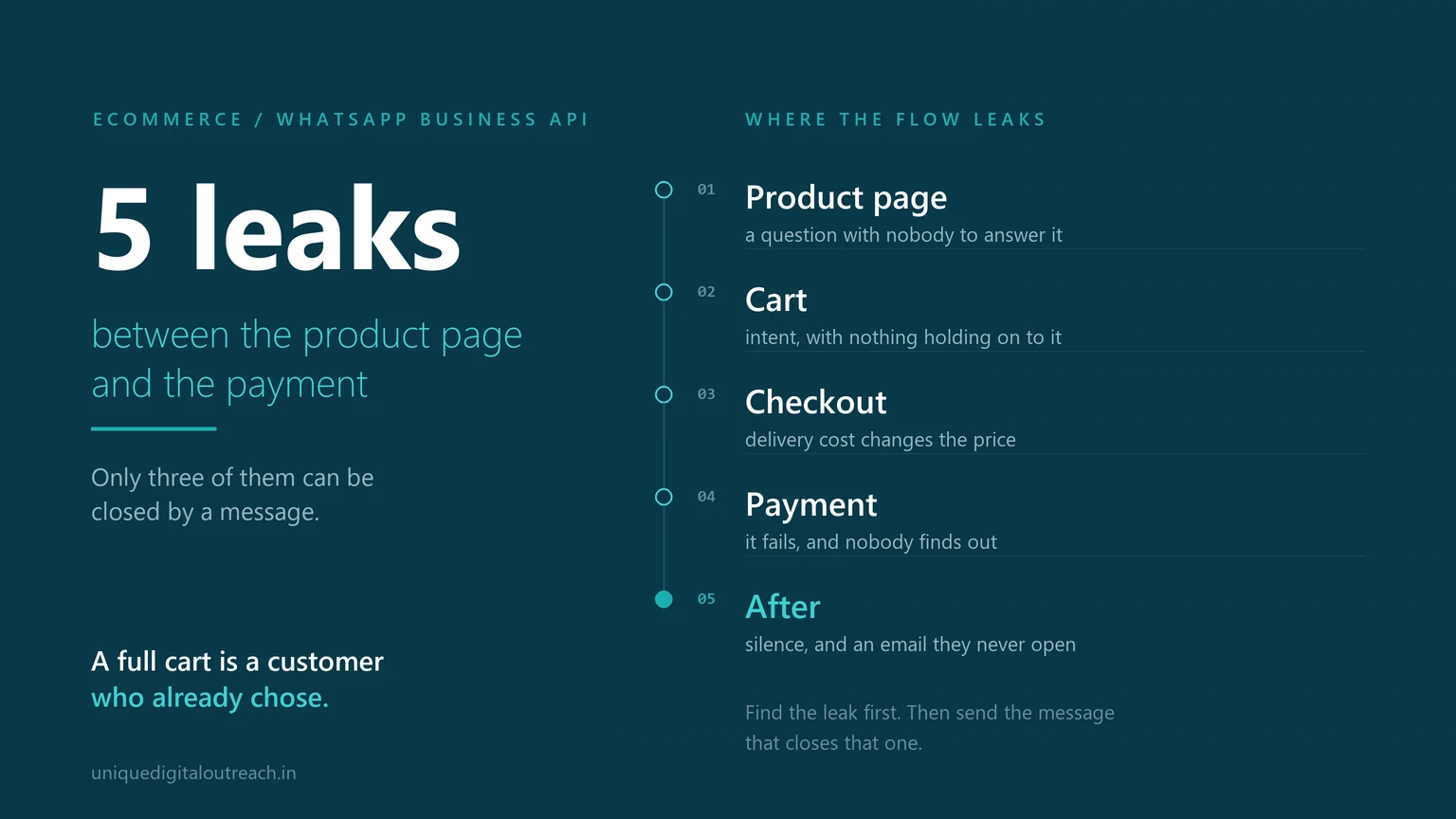
A checkout leaks at five points: an unanswered question on the product page, intent that nothing holds on to in the cart, a delivery cost that changes the price at checkout, a payment that fails silently, and the silence afterwards. The WhatsApp Business API closes three of them — the failed payment, the unanswered question, and being forgotten.
Find the leak → send the message that closes that one → stop when they answer or go quiet
- Product page: a question with nobody to answer it, so they open another tab.
- Cart: real intent, with nothing holding on to it once the session ends.
- Checkout: delivery cost appears and the price is no longer the one they agreed to.
- Payment: the card declines or the app switch fails, and nobody finds out.
- After: silence, and an email that is never opened.
What are the five leaks in a checkout flow?
The five leaks run in sequence, and each one loses a different kind of customer — which is why a single reminder template sent to everyone recovers so little.
| Stage | What they are thinking | What closes it |
|---|---|---|
| Product page | “Will this fit? When does it arrive?” | A chat entry point on the page, so the question is answered before they leave |
| Cart | “I’ll come back to this later” | An opt-in at the cart, so later is a conversation you can start |
| Checkout | “It was cheaper a minute ago” | Nothing a message can fix — the fix is showing the full price earlier |
| Payment | “It didn’t go through, I’ll try later” | A fresh payment link in the thread, minutes after the failure |
| After | Nothing — they have moved on | A reminder in the app they open, carrying the cart back |
Three of these five are messaging problems. The other two are pricing and checkout problems wearing a messaging costume.
How do you find your own leak before sending anything?
Look at where the drop is steepest in your own funnel: between product page and cart, between cart and checkout, or between checkout and paid. The biggest gap is your leak, and it tells you which message to build first.
A drop between cart and checkout usually means price — the total changed when delivery was added. A drop at the payment step means friction or failure, not intent. A drop after checkout loads, with the address already filled in, is almost always a payment that did not complete.
This matters because the messages are different. Sending a generic “you left something behind” to a customer whose payment failed reads as a sales nudge when what they needed was a working link.
Which leaks does the WhatsApp Business API close?
The WhatsApp Business API closes three leaks: a payment that failed, a question nobody answered, and a cart that was simply forgotten.
The failed payment. This is the most recoverable of all, because nothing was wrong with the decision — only the transaction. A message minutes later with a fresh link, going straight back to the same basket, catches a customer who still wants the item and assumes the order is lost.
The unanswered question. If a shopper asks about sizing, delivery or returns and gets an answer inside the conversation, the objection dies there. Inside the 24-hour window after a customer writes to you, a person can answer freely without a template — which is why fast replies are both better service and simpler messaging.
The forgotten cart. An interrupted shopper does not need persuading, only reminding, and a reminder in a chat thread is read where an email is not. The cart contents and one link back are enough; the discount most shops reach for is usually paying for a sale they would have had anyway.
Source: Meta, WhatsApp Business Management API: message templates, on templates and the customer service window.
Which leaks can messaging not fix?
Two of the five are not messaging problems at all: a price that changes at checkout, and a checkout that is hard to complete. No template repairs either of them.
If delivery cost appears only at the final step, a reminder simply returns the customer to the same unwelcome number. The fix is showing the full price on the product page. If the flow demands an account before it will take money, the fix is letting people buy without one.
Sending messages into those two leaks produces the worst outcome available: the cost of the campaign, the irritation of the customer, and no recovered revenue. Fix the flow, then message the leaks that remain.
When should each message go out?
Send the first message within the hour, a second after about a day if there is something genuinely new to say, and nothing after the third — silence is an answer.
- Within the hour: the cart and one link back. For a failed payment, a working link instead.
- After a day: answer the objection you think stopped them — delivery time, returns, sizing. Not a louder version of the first message.
- After three days: a last one only if something real has changed, such as stock running down. Otherwise leave it.
- Then stop: no reply across the sequence means no more messages for that cart.
Three is not a rule handed down by Meta; it is the point at which a reminder becomes a nuisance, and a nuisance on WhatsApp costs more than a lost cart. People block businesses that overstay, and a blocked number cannot recover anything.
What rules apply to cart messages on WhatsApp?
Two rules govern every cart message: the customer must have opted in before you message them first, and the message needs an approved template in the right category.
A cart reminder promotes a purchase that was never completed, so it is sent as a marketing template rather than a utility one. That is not a technicality — it decides the consent you need and how the message is treated. A payment-failure notice relates to a transaction the customer actually attempted, which is a different conversation and a different category.
Opt-in is best collected at the cart itself, where the intent already exists: a checkbox, a chat entry point, or the customer starting the conversation. Whichever route you take, record it.
Note also that DLT registration does not apply here. It governs SMS carried over Indian mobile networks; WhatsApp uses Meta’s own template approval instead.
Source: Meta, WhatsApp Business Platform pricing and message templates.
How does a recovered cart become a repeat customer?
A recovered cart hands you something a first-time buyer never gives: a live conversation with someone who has now paid. That thread is where the second order comes from.
The messages that follow are utility, not marketing — dispatch, delivery, and the reorder reminder timed to when the product actually runs out. They are welcome, they are cheaper, and they keep the thread alive without consent fatigue.
Recovery is the first sale back. Retention is every one after it, and our guide to increasing repeat purchases covers the sequence that follows this one.
How does UDO set this up for an online store?
UDO connects your store to the WhatsApp Business API, writes the templates each leak needs, and wires the triggers so a cart event or a failed payment fires the right message without anyone watching a dashboard.
Billing is per delivered message, with no account opening fee and no monthly subscription — you can see pricing for the current rates by category. As an Official Meta Tech Provider, we handle the verification and the template submissions, so your team works from a catalogue and an inbox.
- One provider for every channel: WhatsApp, SMS, RCS and voice on one account, so a failed payment can fall back to SMS when the first message does not land.
- Connects to your store: Salesforce, HubSpot, Zoho, Freshdesk, CleverTap and MoEngage, or your own platform through the REST API.
- Billed on delivery: you pay for messages that arrive, not for messages attempted.
- Catalogue built in: products and prices can travel inside the conversation — see our guide to the WhatsApp catalogue.
- Onboarding handled: our team does the setup, and a store can start the same day.
- Support in your time zone: an India-based team that knows Meta’s template rules.
Source: Unique Digital Outreach, pricing page and WhatsApp Business API, read 25 September 2026.
Close the leak that is costing you most
Frequently asked questions
Cart abandonment is when a shopper adds items to a cart and leaves without paying. It is usually treated as one problem, but a checkout leaks at five different points, and the reason a particular customer left decides whether a message can bring them back.
Yes, for three of the five leaks: a payment that failed, a question nobody answered, and a cart that was forgotten. It cannot fix a price that changes at checkout or a checkout that is hard to complete — those are flow problems, not messaging problems.
A cart reminder is a marketing message, because it promotes a purchase that was never completed. A notice about a payment that failed relates to a transaction the customer attempted, which is treated differently. The category decides the consent you need.
Yes. An opt-in is required before you message a customer first, and it should be recorded. The natural place to collect it is the cart itself, where the intent already exists.
No more than three, and stop as soon as the customer replies or ignores the sequence. Businesses that keep messaging get blocked, and a blocked number recovers nothing from anyone.
Within the hour, while the intent is still warm and the decision is still fresh. For a failed payment, sooner — the customer often assumes the order is gone and will not try again unless prompted.
Usually not in the first message. Most abandoned carts are interruptions rather than price objections, so an immediate discount pays for sales you would have recovered anyway. Save it for the customers who told you price was the issue.
Yes, and that is the advantage over email. A reply opens a 24-hour window in which your team can answer without a template, so an objection about sizing or delivery can be resolved in the same thread that carried the reminder.
No. DLT governs SMS carried over Indian mobile networks. WhatsApp messages travel over the internet and use Meta’s template approval instead, so a store sending both carries both sets of paperwork.
Recovered orders and the revenue attached to them, split by which leak the message addressed. Open rates flatter this channel and tell you nothing about whether the cart was recovered.
Sources — all read on 25 September 2026.
- Meta, WhatsApp Business Management API: message templates: template approval, categories, and the 24-hour customer service window.
- Meta, WhatsApp Business Platform pricing: how marketing, utility and authentication messages are categorised.
- Unique Digital Outreach, pricing page: billing per delivered message, with no account opening fee and no monthly subscription.