The DLT full form is Distributed Ledger Technology, the blockchain-based registry Indian telecom operators use to record who is allowed to send business SMS. If the letters turned up in a chat with your SMS provider, on a rejected message template, or in a quote from an agency, that registry is what they are pointing at.
How this guide was checked: the rules below come from TRAI’s commercial communication regulations as amended in February 2025, read on 23 September 2026. WhatsApp’s side comes from Meta’s own developer documentation. Each section names its source.
What does DLT stand for?
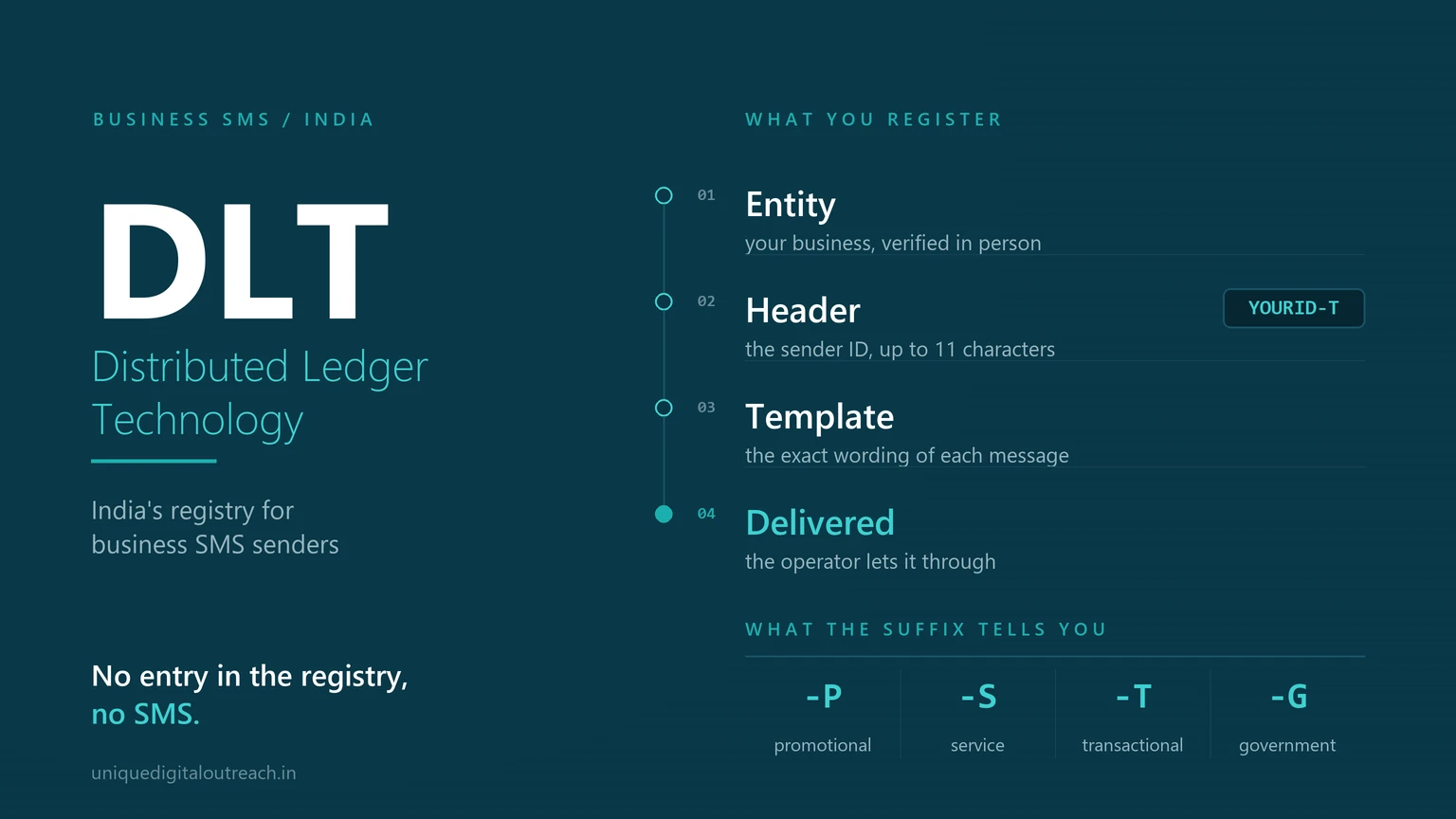
DLT stands for Distributed Ledger Technology. In Indian messaging it means TRAI’s sender registration system, where your business, your sender ID and the exact wording of every message are recorded before an operator will deliver your SMS.
Register the business → register a header → register each template → the operator delivers
- Your business: registered as a principal entity, with the authorised person verified in person, which is what produces a PE ID.
- Your header: the sender ID your SMS arrives from, up to 11 characters, with a suffix that declares the message type.
- Your templates: the wording of each message, with the changing parts marked as variables.
- Your links and numbers: every URL, app file and callback number the messages contain, whitelisted in advance.
Source: TRAI, Telecom Commercial Communications Customer Preference (Second Amendment) Regulations, 2025.
- 11 characters: the maximum length of a header, the sender ID your message shows instead of a phone number.
- 4 suffixes: -P, -S, -T and -G, which mark a header as promotional, service, transactional or government.
- 30 minutes: the window in which a transactional message must follow the customer’s own transaction.
- 30 characters: the limit on each variable inside a registered template.
- 3 variables: a template with more than three needs a justification when you register it.
- 90 days: how long an unused template survives before it is deactivated automatically.
Source: TRAI, Second Amendment Regulations, 2025, dated 12 February 2025.
Why are you seeing DLT in a chat?
DLT usually appears in a chat for one of three reasons: your provider is asking you to register before they can send, a template you submitted was rejected, or a message you sent was blocked on its way to the customer.
All three trace back to the same rule. In India, a business SMS is not accepted on its content alone — the operator matches the sender, the header and the text against what is recorded in the registry first. Anything that does not match is stopped before it reaches a handset, which is why so many messages that appear to send never arrive.
The acronym itself causes some of the confusion. The DLT full form, Distributed Ledger Technology, describes the same family of technology as a blockchain, and it is used here for a plain reason: operators need one shared, tamper-evident record that all of them can read.
Source: Unique Digital Outreach, SMS gateway and SMS API — the five stages a message passes through, including DLT scrutiny.
What do you actually register on DLT?
You register four things on DLT: your business as a sender, the header your messages come from, a template for every message you intend to send, and every link or callback number those messages carry.
| What you register | What it is | Where you meet it |
|---|---|---|
| Entity | Your business, recorded as a principal entity once the authorised person has been verified in person and a mobile number linked to them | As the PE ID your provider asks you for |
| Header | The sender ID a customer sees, up to 11 characters, tied to one message type | At the top of the SMS, in place of a phone number |
| Template | The fixed wording of one message, with the changing parts marked as variables | In a rejection notice, when the text does not match |
| Links and numbers | The URLs, app files and callback numbers your messages are allowed to contain | When a message with an unlisted link is stopped |
One template is tied to one header, so the same wording sent from a different sender ID counts as a new registration.
Sources: TRAI, Second Amendment Regulations, 2025; the IDs themselves are broken down in PE ID, template ID and header ID explained.
What do -P, -S, -T and -G mean on a sender ID?
The suffix on a header declares what kind of message it carries: -P for promotional, -S for service, -T for transactional and -G for government.
It matters because the category decides who the message may reach. Promotional messages go only to customers who have not blocked that category or who have consented, and they must carry a way to opt out. Government messages reach even customers who have blocked everything else.
| Suffix | Message type | The rule attached to it |
|---|---|---|
| -P | Promotional | Carries an opt-out, and reaches only customers who have not blocked the category or who have consented |
| -S | Service | Information about something the customer already uses, such as a delivery or a balance alert. No consent needed |
| -T | Transactional | Follows the customer’s own transaction within 30 minutes, which is where bank and login OTPs sit |
| -G | Government | Reaches customers even when they have blocked all other commercial messages |
A message that mixes promotion into a service or transactional template counts as promotional, and is filtered as such.
Source: TRAI, Second Amendment Regulations, 2025 — header format and the promotional, service, transactional and government definitions.
Does WhatsApp need DLT registration?
No. WhatsApp does not use DLT — the registry covers messages carried over mobile networks, and WhatsApp messages travel over the internet instead, so Meta approves the templates rather than an Indian operator.
The approval still exists, it is just held somewhere else. On the WhatsApp Business API you submit message templates to Meta, they are reviewed against Meta’s own policies, and only approved templates can be sent to a customer outside an open conversation. There is no PE ID, no header and no operator whitelist.
If you send both SMS and WhatsApp, you carry both sets of paperwork: DLT for the SMS side, Meta template approval for the WhatsApp side. The same applies to the message wording, which has to be registered separately for each channel even when the text is identical.
Source: Meta, WhatsApp Business Management API: message templates.
What does DLT registration not do?
DLT registration does not guarantee delivery — it only makes a message eligible to be delivered, and a registered sender can still be stopped by a template mismatch, an unlisted link, or a customer’s own preferences.
- It does not protect the wording forever: a template that goes unused is deactivated after 90 days, so seasonal messages often fail the next time they are needed.
- It does not allow free text: the changing parts of a message are variables, capped at 30 characters each, and more than three of them needs a justification.
- It does not cover your links automatically: URLs, app files and callback numbers are checked against your whitelist, along with an undertaking that they are not malicious.
- It does not override customer choice: promotional messages still reach only those who have not blocked the category or who have consented.
Source: TRAI, Second Amendment Regulations, 2025 — template, variable, whitelist and preference rules.
Where do you register for DLT?
You register on a telecom operator’s DLT portal — Jio, Airtel, Vi and BSNL each run one — and because the record is a shared ledger, the entity you register with one operator is recognised by the others.
Which portal you start with is usually decided by your provider rather than by you, since the headers and templates have to be registered where your messages will be routed. Registration itself involves verification of the business and biometric authentication of the authorised person, so it is not something that completes in an afternoon.
The process, the documents and the charges are covered separately in our main guide.
Full walkthrough: DLT registration in India, explained, and the DLT approval process step by step.
How does UDO handle DLT for its customers?
UDO runs a DLT-compliant SMS platform: every message goes out from a registered header against an approved template, and the team helps customers register new headers and templates and fix the ones that come back rejected.
That matters most at the point where messages fail. A rejected template or an unlisted link looks like a delivery problem from the outside, and tends to be diagnosed as one — which is why our guide to getting a DLT template ID exists alongside this one. Billing is on delivered messages, with no setup fee and no subscription.
Source: Unique Digital Outreach, bulk SMS service — sender IDs and templates registered on the DLT platform, and pricing for the delivered-message terms.
Send SMS that clears the DLT checks
Frequently asked questions
The DLT full form is Distributed Ledger Technology. In Indian telecom it refers to the registry operators use to record business senders, their sender IDs and their message templates, so that only registered messages are delivered.
In a chat about business messaging, DLT means the sender registration your SMS has to pass before an operator will deliver it. Someone asking whether you are “DLT registered” is asking whether your business, your sender ID and your message wording are recorded in that registry.
Yes, for any business sending commercial SMS through Indian mobile operators. Messages from senders, headers or templates that are not registered are filtered out by the operator rather than delivered, so registration is what makes sending possible at all.
No. DLT applies to messages carried over mobile networks. WhatsApp messages travel over the internet, and their templates are approved by Meta instead, so there is no PE ID, header or operator whitelist on the WhatsApp side.
A PE ID is the principal entity ID issued when your business finishes DLT registration. It identifies your company in the registry and is what a provider asks for before attaching headers and templates to your account.
A DLT template ID identifies one registered message wording. The operator matches the text you send against that template, so anything outside the registered wording, other than the marked variables, is rejected.
Usually because the wording does not match what a category allows, the variables break the rules, or a link is not whitelisted. Each variable is capped at 30 characters, more than three variables needs a justification, and promotional content inside a service or transactional template makes the whole message promotional.
No. TRAI is the Telecom Regulatory Authority of India, which writes the rules. DLT is the technology operators use to enforce them — a shared registry of senders, headers and templates that every operator can read.
Jio, Airtel, Vi and BSNL each run a DLT portal, and because the ledger is shared, an entity registered with one is recognised by the others. In practice your SMS provider will tell you which portal to start with, based on where your messages are routed.
Yes. An OTP is a transactional message, sent from a header ending in -T, and it still needs a registered template. The transactional category expects the message to follow the customer’s own transaction within 30 minutes, which is how a login or payment code qualifies.
Sources — all read on 23 September 2026.
- Telecom Regulatory Authority of India, Telecom Commercial Communications Customer Preference (Second Amendment) Regulations, 2025, dated 12 February 2025: header format and suffixes, the promotional, service, transactional and government definitions, the 30-minute transactional window, template and variable limits, link whitelisting, and sender verification.
- Meta, WhatsApp Business Management API: message templates: how templates are submitted and approved on the WhatsApp Business Platform.
- Unique Digital Outreach, bulk SMS service and pricing: registered sender IDs and templates, and billing on delivered messages.