WhatsApp for healthcare
WhatsApp Business API for healthcare, between visits.
The WhatsApp Business API for healthcare lets hospitals, clinics and diagnostic labs send appointment reminders, report-ready alerts and follow-ups from one verified number, triggered by the systems they already run. Patients confirm, reschedule or ask a question in the app they already use, and only people who agreed to hear from you are messaged.
Official Meta Tech Provider · Opt-in messaging only · Trusted by 1,000+ businesses worldwide
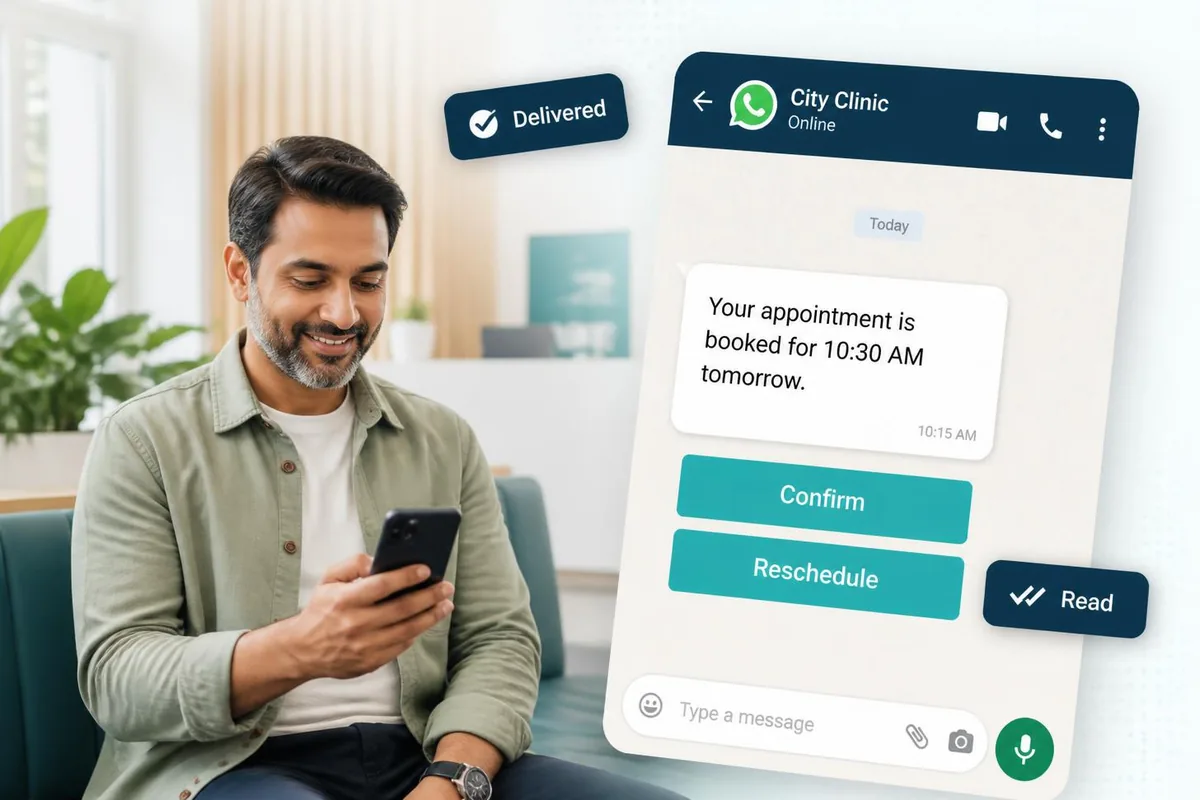

The patient journey
What do hospitals and clinics send on WhatsApp?
Mostly utility messages tied to a booking or a test: confirmations, preparation instructions, report-ready alerts and follow-up prompts, each sent the moment your system records the event.
The first message
A patient asks about a doctor or a test and is booked in the same thread: date, time, a location pin and Reschedule as a button rather than a phone number.
Before the visit
Fasting instructions for a blood test, documents to bring, which entrance and which floor.
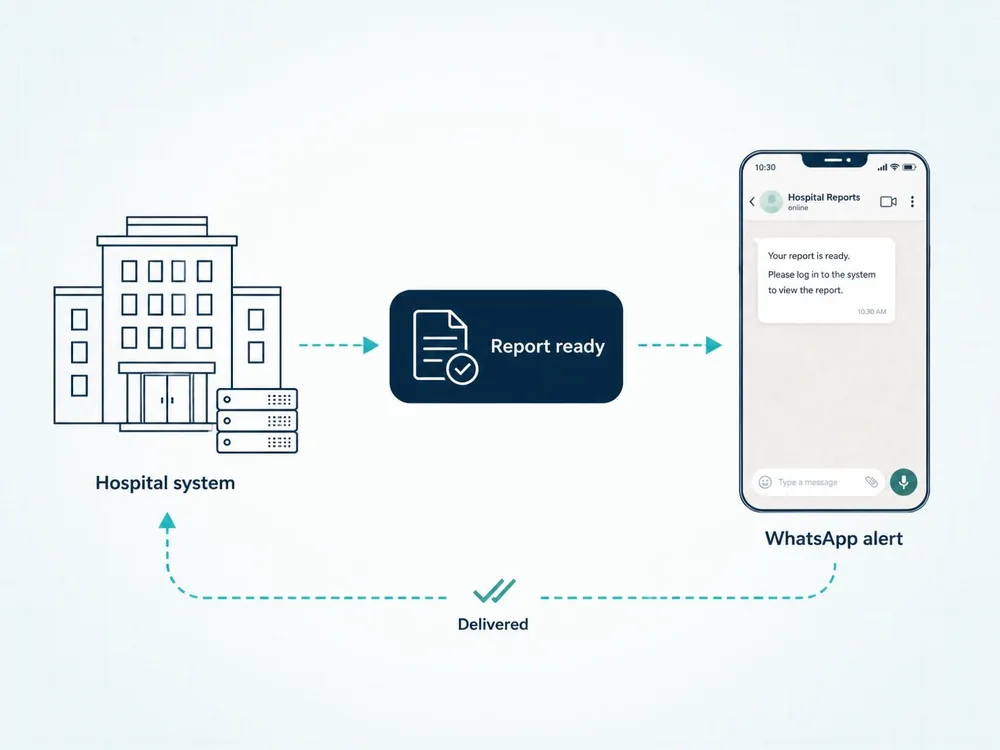
Results signed off
An alert that results are available, with a link to your patient portal behind a login.
After discharge
A check-in after a procedure, with a button that reaches the care team, not a call queue.
Next one due
Vaccinations, repeat tests and annual check-ups, sent on the date they fall due.
Continuity of care
Patients are rarely lost at the appointment. They are lost between appointments.
A review nobody reminded them about, a repeat test booked at whichever lab was nearest, a complaint that went to a review site instead of to you. Each one is a message that was never sent.
Reviews that actually happen
When the doctor asks to see a patient again, the reminder goes out on the due date with the booking link inside it.
Chronic care that stays with you
Diabetic, thyroid and cardiac patients need regular tests. A scheduled reminder brings them back to your lab rather than the closest one.
Feedback before it goes public
Ask how the visit went inside the same thread, so a problem reaches your patient-relations team first.
Patient privacy
Can hospitals share patient information on WhatsApp?
Yes, within limits: India's telemedicine guidelines allow chat platforms such as WhatsApp, but patient consent, keeping clinical detail out of the message, and Meta's own policy decide what each template may say.
Consent comes first
Meta's WhatsApp Business Messaging Policy allows you to contact only people who gave you their number and opted in. The Digital Personal Data Protection Act, 2023 adds, once its consent rules take effect on 13 May 2027, that consent must be for a stated purpose and as easy to withdraw as it was to give. Capture it at registration or on your website form, and keep a record of it.
The appointment, not the diagnosis
A template names the visit, the time and the place. Results travel as a "report ready" alert with a link to a portal behind a login, so a phone left on a table never shows a diagnosis.
The doctor is identified
The Telemedicine Practice Guidelines, 2020 allow registered medical practitioners to consult over chat platforms, and expect the practitioner's registration number on prescriptions and electronic communication.
No ID numbers in chat, and opt-outs honoured
Meta's policy bars asking patients to type full ID card or account numbers into a thread, and requires you to honour every request to stop. Each promotional template carries a clear way to opt out, and that number is left out of every send after it.
WhatsApp Business Messaging Policy (updated 23 September 2026) · Telemedicine Practice Guidelines, Ministry of Health and Family Welfare, 25 March 2020 · Digital Personal Data Protection Act, 2023 · Digital Personal Data Protection Rules, 2025 (notified 13 November 2025; the consent rules apply from 13 May 2027). Meta's policy also bars using WhatsApp for health information wherever local law demands systems with heightened safeguards, so if you treat patients outside India, that country's rules apply. Your compliance team approves the final templates; we build the flows to match.
Use cases by provider
How do hospitals, clinics and labs use the WhatsApp API?
Each uses it for a different job: hospitals to route conversations by department, clinics to bring patients back for review visits, labs to book home collection and announce reports. International patient desks, teleconsultation platforms and pharmacies use it too, each within its own rules.
Multi-specialty hospitals
Every patient writes to one number, and the shared inbox hands each conversation to the right department, from a cardiology booking to a billing query. With the patient's recorded consent, the family waiting outside also gets admission, discharge and insurance pre-authorisation updates.
Clinics and specialists
The review date a doctor sets at the consultation becomes a reminder on the day it falls due. The patient replies in that thread to pick a time or ask something, and the doctor's assistant answers from the clinic's number.
Diagnostic labs
A patient messages to ask for a home visit, the chatbot takes the address and a preferred time, and the report alert arrives later in the conversation where the booking began.
International patient desks
A patient planning treatment from abroad keeps one thread with your coordinator, from the first enquiry and estimate to admission and the check-in after they fly home. WhatsApp reaches them in the app they already use, iPhone or Android, and their own country's health-data rules apply under Meta's policy.
Teleconsultation platforms
Booking, the consultation link, the doctor's details and the follow-up, all in the thread the patient already trusts.
Pharmacies
Order-ready and delivery updates for orders placed on your own site or in store. Meta's Business Messaging Policy bars buying, selling, promoting or facilitating the sale of prescription medicines and medical products on WhatsApp, so these messages carry no medicine names, offers or re-order links. Your compliance team approves each template.
Running SMS, RCS or voice alongside WhatsApp? See messaging for healthcare across every channel, or RCS for healthcare for Android's native inbox.
How it works
Wired into the systems your hospital already runs.
The message fires when the event happens in your software, not when someone remembers to send it.
Triggered by your hospital system
Your hospital management, lab or practice software calls our REST API when a booking is made, a result is signed off or a patient is discharged. The approved template goes out with that patient's details filled in, and the delivery status comes back by webhook.
- Booking created, changed or cancelled
- Sample collected, report signed off
- Discharge summary issued, follow-up due
- Salesforce, HubSpot, Zoho and Freshdesk connect directly
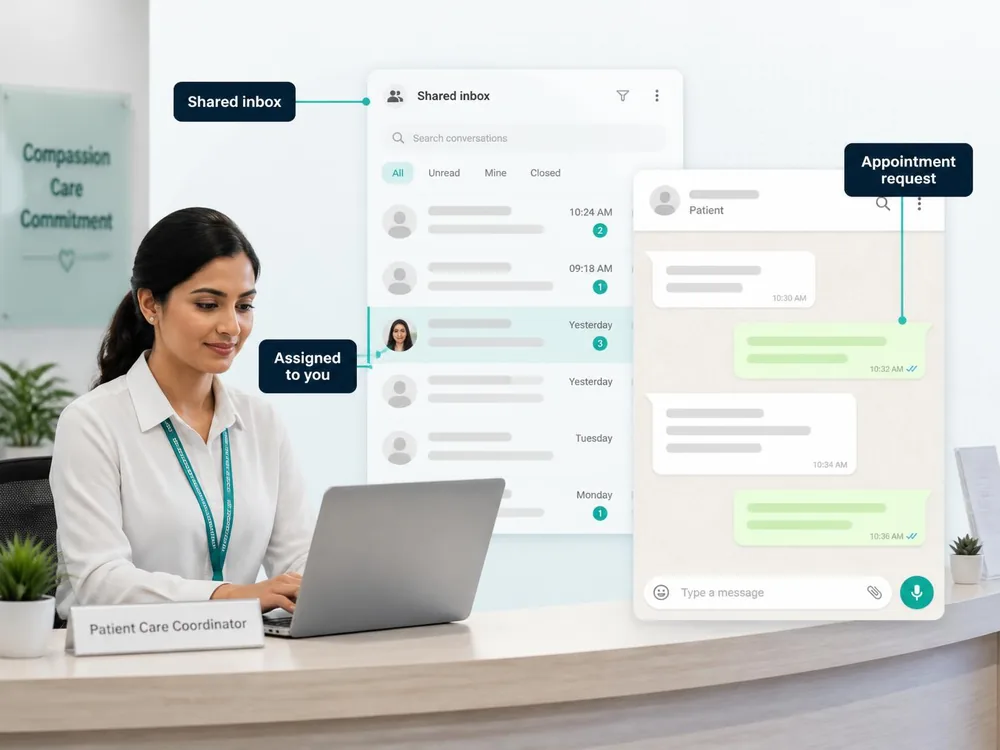
One number for the whole front desk
Every receptionist, coordinator and nurse works the same verified number from a shared inbox. A chatbot answers timings, directions and doctor availability, and hands anything clinical to a person with the full thread in view.
- Conversations assigned by department
- Chatbot for the questions the desk answers all day
- Handover to staff the moment a question turns clinical
- Booking and reschedule as buttons, not typed replies
Template categories
Which kind of message is each healthcare template?
Most patient messages are utility templates; offers and health camps are marketing; portal logins are authentication. Meta assigns the category when it approves the template, and the category decides how the message is billed.
| Message | Category | What it needs |
|---|---|---|
| Appointment confirmation and reminder | Utility | Opt-in and an existing booking |
| Report-ready alert | Utility | A link to your portal, not the result itself |
| Post-discharge check-in | Utility | Tied to that patient's own stay |
| Patient-portal login code | Authentication | A one-time code and nothing else |
| Health check-up package or screening camp | Marketing | Opt-in to promotional messages |
How each category is priced · Login codes over WhatsApp, SMS and voice
Questions
Frequently asked.
It is Meta's official platform for sending and receiving WhatsApp messages at scale, which hospitals, clinics and labs use to automate appointment reminders, report alerts and follow-ups from one verified number.
Unlike the WhatsApp Business app, it connects to your hospital system and lets a whole front-desk team answer from the same number.
The safer pattern is a "report ready" alert with a link to your patient portal behind a login, rather than the report itself.
Attaching a report is possible where the patient has consented to it and your own data policy allows it. Meta's policy also bars health information wherever local law demands systems with heightened safeguards.
Yes, patients can book on WhatsApp: a booking flow offers departments, doctors and open slots as buttons and lists, writes the booking to your system through our REST API, and confirms it in the same thread.
Rescheduling and cancelling work the same way, so the slot is freed for someone else.
Yes, consent is required: Meta allows business-initiated messages only to people who shared their number and opted in. From 13 May 2027 the Digital Personal Data Protection Act, 2023 also requires that consent be for a stated purpose and as easy to withdraw as it was to give.
Collect it at registration, at the front desk or on your website form, and keep a record of it.
Yes, to patients who opted in: a clinic sends one Meta-approved template to its whole list, with each patient's name and appointment filled in. Reminders go as utility templates and check-up offers as marketing, and every patient can opt out.
The send can be a single campaign to the full opted-in list, or fired by your practice software through our REST API as each appointment falls due.
In India, yes: the Telemedicine Practice Guidelines, 2020 permit registered medical practitioners to consult over chat platforms such as WhatsApp, with the practitioner's registration number shown on prescriptions and electronic communication.
If you treat patients in other countries, check that country's rules first; Meta's policy defers to them.
Yes, through our REST API: your hospital, lab or practice software calls it when a booking, result or discharge happens, and the right template goes out.
Salesforce, HubSpot, Zoho and Freshdesk connect directly. The API documentation covers endpoints and webhooks.
Per delivered message, by category: utility for reminders and report alerts, marketing for check-up offers, authentication for portal logins. From 1 October 2026 Meta also charges for the free-form replies your team or chatbot sends inside the 24-hour customer service window, once a business number has sent its first 1,000 in a month, and for utility templates sent while that window is open. There is no setup fee and no subscription.
See how the categories work, or see the rate card. Ask us how replies are billed on your account.
Put the reminder where the patient will read it.
Tell us what your front desk sends today and which system holds the bookings. We will show you the same journey on WhatsApp, with the consent step built in.