For hospitals, labs and clinics
RCS for healthcare: patient messages that look official, because they are.
RCS messaging for healthcare sends a patient's reminder as a card from the hospital's or lab's verified name, carrying Confirm, Reschedule and Get directions buttons instead of a number to call back. UDO sends it into the patient's own messaging app and switches to SMS for any phone that cannot show it.
Verified provider identity · Confirm or reschedule in one tap · Trusted by 1,000+ Businesses Worldwide
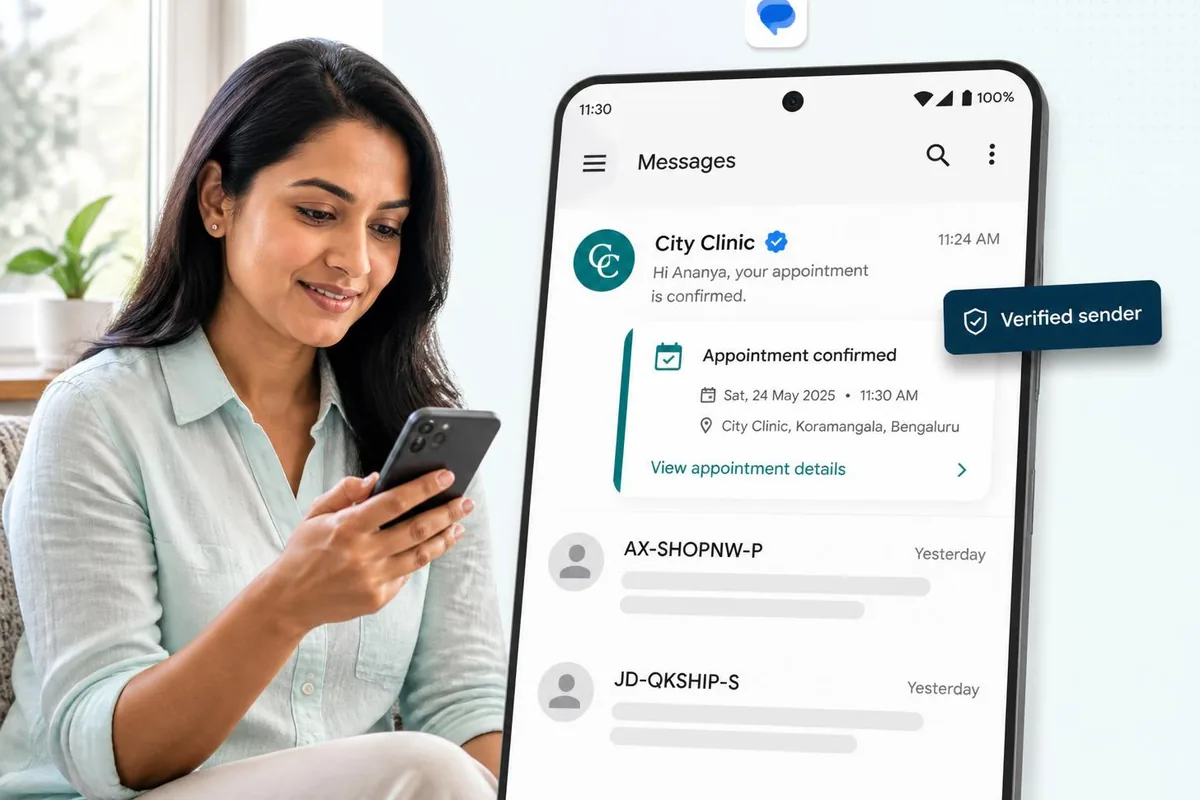
The patient journey
Where does RCS fit in healthcare, from booking to follow-up?
In healthcare, RCS fits five moments where a patient has to act: confirming a booking, remembering it, finding the place, collecting results and coming back for follow-up. Each is a message you already send; RCS turns each into a card with the next step built in.
The booking card
Doctor, date and an "Add to calendar" button, under your verified name.
The day-before card
Confirm, Reschedule or Cancel as one-tap suggested replies.
The map button
"Get directions" opens at the right building and entrance.
The report notice
One line, and a "View report" button to the secure portal.
The follow-up card
Review visit, refill or repeat test, booked from the card.
What the patient sees
Two cards that do the work of a phone call.
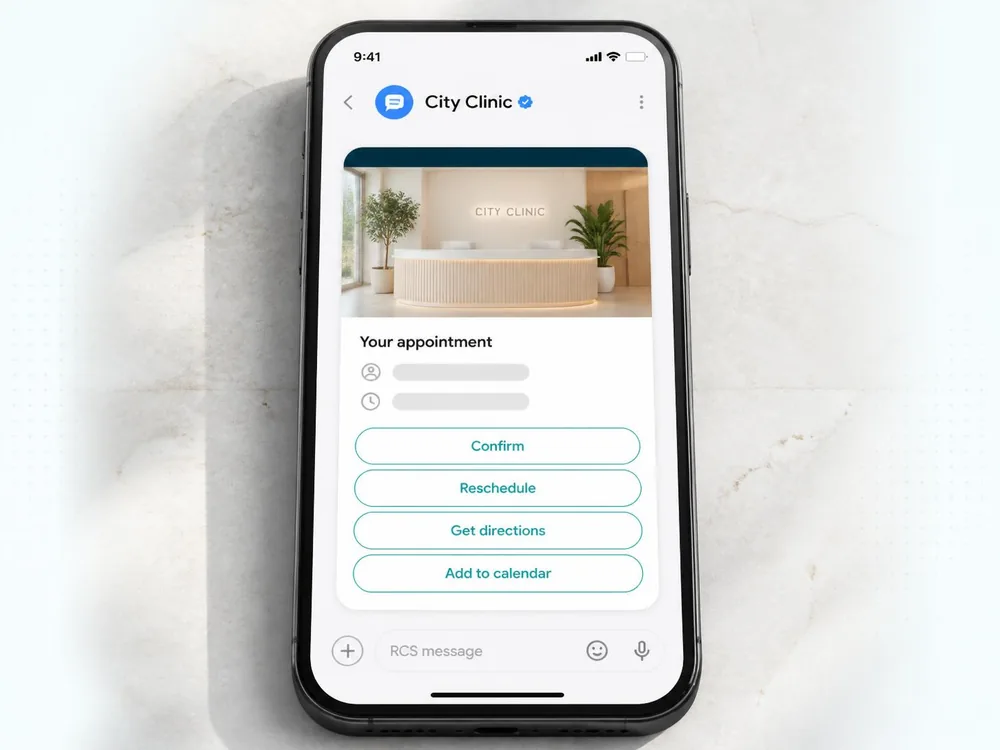
The appointment card
One card replaces the reminder calls a front desk makes every evening. It carries the doctor's name, the time and any preparation that applies to everyone booked for that test, such as fasting before a blood draw.
- "Confirm" and "Reschedule" as suggested replies, answered in one tap
- "Get directions" opens the map at the correct entrance, not just the campus
- "Add to calendar" writes the slot into the patient's own calendar
- Every confirmation flows back to your scheduling system over the API
The report-ready notice
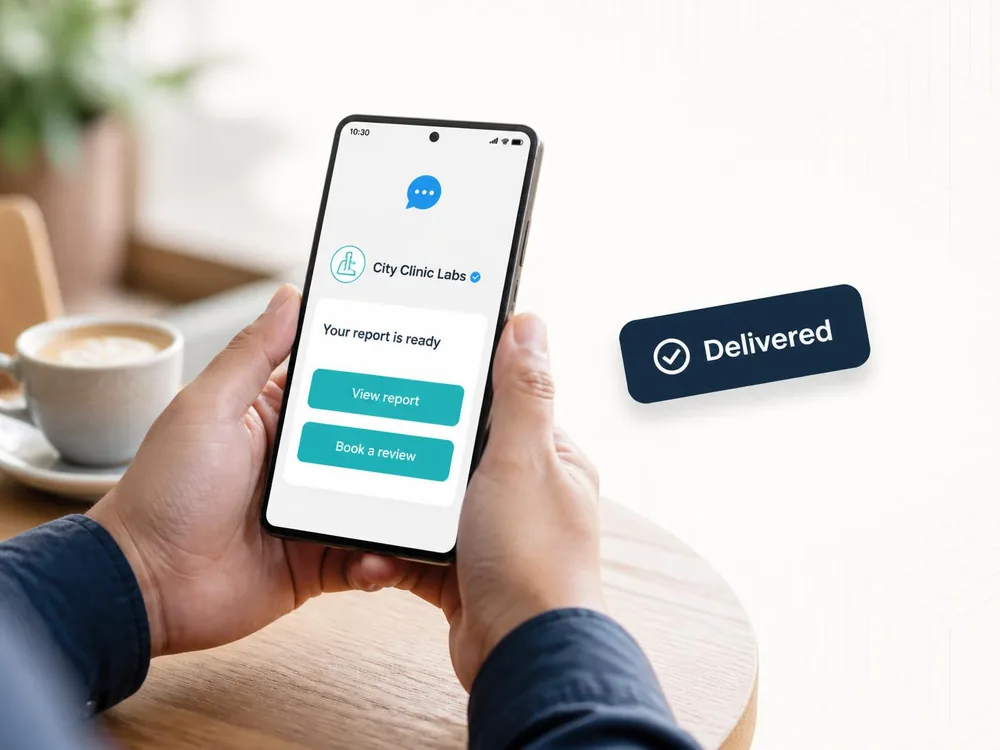
The card says a report is ready and nothing more. The result itself stays behind a "View report" button that opens your patient portal, where the patient signs in before anything clinical appears.
- No diagnosis, values or test names in the message body
- "Book a review" for results that need a consultation
- Read receipts show which patients have not opened their notice
RCS or SMS
How does an RCS appointment reminder differ from the SMS one?
The RCS reminder arrives under the hospital's verified name and logo, with buttons that confirm or move the slot; the SMS version arrives from a DLT-registered header, and the patient has to call, type a reply or open a link to act. UDO sends the SMS version automatically to any phone that cannot show the card.
| What the patient gets | RCS reminder | SMS reminder |
|---|---|---|
| Who it is from | The hospital's verified name and logo | A DLT-registered header, shown with -S or -T at the end |
| How they answer | Confirm, Reschedule and Get directions buttons | A number to call, a keyword to reply or a link |
| Proof they saw it | Delivered and read receipts | A delivery report only |
| Hindi, Tamil or another script | Up to 3,072 characters in one message | 70 characters per SMS in Unicode, against 160 in English |
| A phone that cannot show RCS | Gets the SMS version instead | Reaches basic phones and smartphones alike |
What changes at the front desk
- Fewer call-backs: a tap on Confirm or Reschedule updates the slot in your booking system.
- Targeted calls: read receipts show who has not opened the reminder, so staff call only them.
- One message in any script: a Hindi or Tamil reminder is not split across several SMS.
- No patient left out: basic phones still get the SMS.
Sources: Google, Send messages, for the 3,072-character text limit and suggested replies; TRAI, TCCCPR Second Amendment, 2025 (PDF, 1.8 MB), for the -S and -T header suffixes. Last verified .
Patient privacy
What belongs in the message, and what stays behind the sign-in.
Appointment details, the provider's name and a notice that a report is ready belong in the message; results, diagnoses, prescriptions and anything that reveals a condition stay behind a secure sign-in. Verified RCS chats between a business and a patient are not end-to-end encrypted (Google Messages Help, RCS chats with businesses), and lock screens show previews, so write every card as if someone else might read it.
Safe in the card
- Appointment date, time and the doctor's name
- The provider's name and address
- Preparation that applies to everyone, such as fasting
- A notice that a report or prescription is ready
Behind a secure button
- Test values, diagnoses and imaging
- Prescriptions and medicine names
- A department name that reveals a condition, such as oncology or fertility
- Bills that itemise procedures
Regulation
Which rules govern patient messaging in India?
Today, patient health data in India is protected as sensitive personal data under section 43A of the IT Act and its 2011 rules. The Digital Personal Data Protection Act, 2023 replaces them, and its notice and consent duties come into force in May 2027 under the DPDP Rules, 2025. Either way, message patients only with consent, for a stated purpose, and send only what that purpose needs. Two further sets of rules shape the content.
Consent and purpose
A patient who booked an appointment expects reminders about it. Health-camp invitations and wellness offers are a different purpose, so they need their own consent and an easy way to opt out.
Telemedicine
India's Telemedicine Practice Guidelines (2020) allow consultations by video, audio and text. An RCS card can carry the doctor's name and the joining link; the consultation itself runs on your telemedicine platform.
Medical claims
Promotional health messages fall under Indian advertising law, including the Drugs and Magic Remedies (Objectionable Advertisements) Act. A screening offer can describe the test; it should not promise a cure.
Sources: MeitY, Digital Personal Data Protection Rules, 2025 (PDF, 2.4 MB), notified on 13 November 2025; MoHFW, Telemedicine Practice Guidelines, 2020 (PDF, 1.4 MB); India Code, Drugs and Magic Remedies (Objectionable Advertisements) Act, 1954. Last verified .
Getting set up
What does a hospital need to send RCS?
A hospital needs a verified RCS sender, called an agent, that carries its own name and logo, plus a DLT-registered header and templates for the SMS fallback. UDO sets both up with you in the order below. Google's brand verification is the slowest step, because it waits on Google and on someone at your hospital confirming the details.
Agent profile
Display name, logo, banner image, description, brand colour, phone, website, privacy policy and terms.
Test phones
Your staff try every card on their own phones before any patient sees one.
Brand verification
An authorised person at your hospital confirms the details, and that UDO may run the agent for you.
Launch approval
Google, or the mobile network itself, approves the agent for its network.
Live reminders
Sends begin, with the SMS fallback on your DLT-registered header and templates.
Source: Google, Verify and launch your agent. Last verified .
Who uses it
RCS messaging for hospitals, labs, clinics and pharmacies.
Each kind of provider leans on different RCS buttons and card formats. For every channel a provider uses, see messaging for healthcare across every channel.
Hospitals
A swipeable carousel of the doctors in the department a patient asked about, each with a "Book" button; admission instructions with "Get directions" to the right block; a discharge card whose "Download summary" button opens your portal.
Diagnostic labs
Home-collection times as suggested replies, a "Share location" button so the collector finds the door, and the report notice with "View report" and "Book a review".
Clinic chains
Dental, eye and skin clinics offer the next sitting's open times as suggested replies, and a carousel of branches when the patient can choose where to go.
Pharmacies
Refill-due and order-ready cards with "Get directions" to the store and "Call the pharmacy", with the medicine name kept behind the button.
Questions
Frequently asked.
RCS messaging in healthcare is the use of Rich Communication Services to send patients verified, interactive messages: appointment cards, report notices and follow-up reminders with buttons.
It arrives in the phone's default messaging app, so patients install nothing. How the standard works, with sources.
Not on its own, and for Indian providers it is the wrong test: HIPAA is a United States law, and no messaging channel is compliant by itself, because compliance depends on what you send and how you handle the data.
Indian providers work under India's data protection law: the IT Act's 2011 rules on sensitive personal data today, and the DPDP Act, 2023 as its duties come into force by May 2027. The practical rule is the same either way: notices in the message, clinical detail behind a secure sign-in.
Yes. Suggested replies such as "Confirm" and "Reschedule" come back to your system as structured answers, and patients can also type a reply.
Answers arrive over the API by webhook, so your booking software updates the slot without anyone retyping it.
They receive the same reminder as an SMS. Google Messages delivers RCS to about 95% of Android handsets in India. iPhones can receive it from iOS 18, but only on carriers that support RCS on iPhone, so it is not yet everywhere (Apple Support, Turn on RCS messaging on your iPhone).
Older patients on basic phones are covered by that fallback. For patients who prefer a voice, an automated outbound reminder call is another option.
Yes. Your hospital information system, lab system or booking software calls our REST API when an appointment is made or a report is signed off.
Delivery, read and reply events come back by webhook. The API documentation covers the details.
RCS for reminders and notices to Android patients, because it needs nothing installed and shows your verified name in the default inbox. WhatsApp for longer two-way conversations and patients on iPhone.
Both run from the same platform, so one patient list can be split between them. How providers use the WhatsApp Business API.
Turn the evening reminder calls into one card.
Show us the reminders your front desk sends or makes today. We will rebuild them as RCS cards under your verified name, with the SMS version beside each.