Generating leads is only the first step. The real work is answering quickly, understanding what someone needs, following up at the right time, and turning that exchange into a customer. Traditional funnels lose people at every handover — see the ad, visit the site, fill the form, wait, get a call. Each step is a chance to lose interest.
WhatsApp collapses that sequence into a single conversation. Done properly, lead generation through WhatsApp replaces the form entirely — here is how to build one that works.
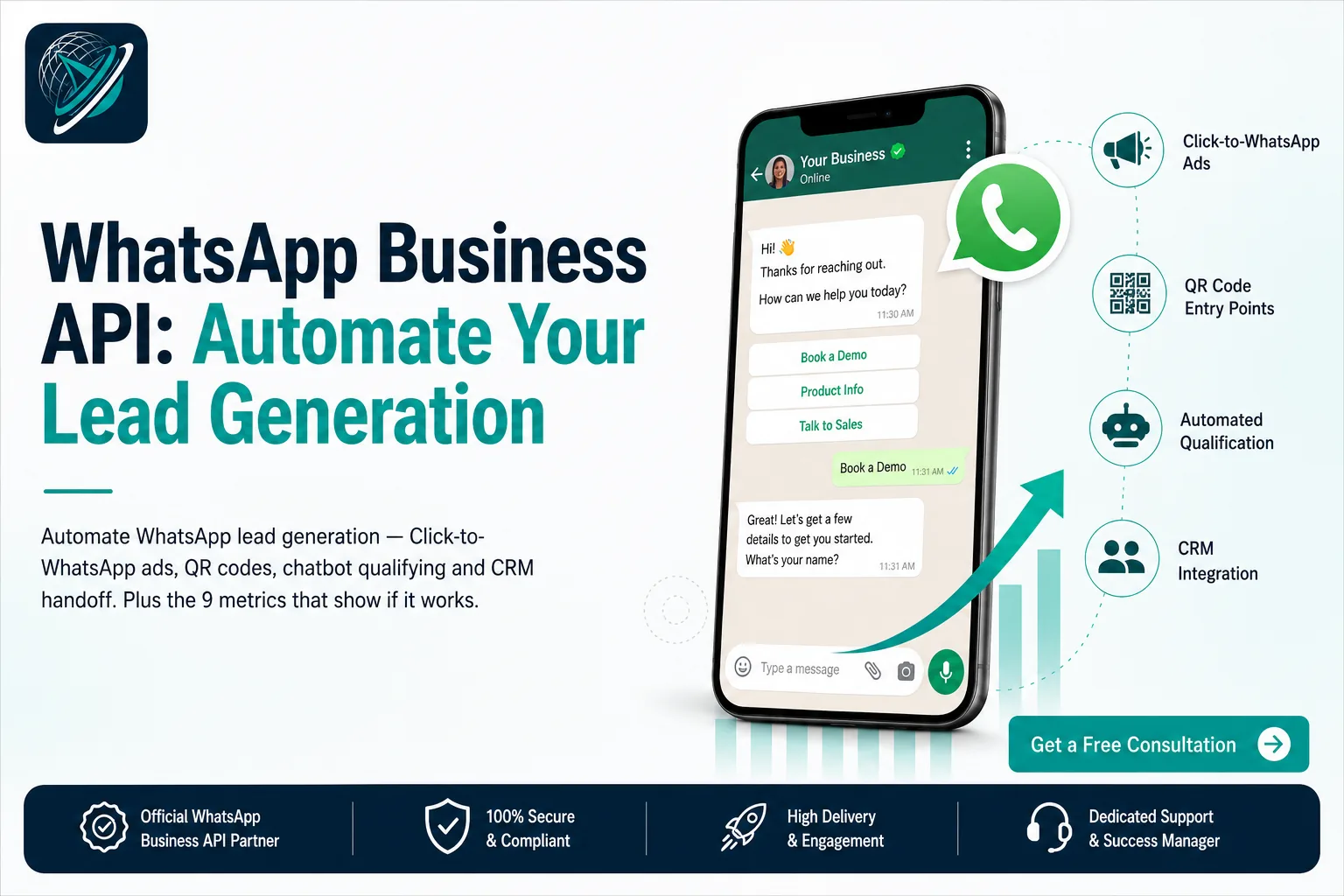
WhatsApp Business API turns lead generation into a conversation. Prospects arrive from Click-to-WhatsApp ads, website buttons or QR codes; an automated welcome flow asks what they need; interactive buttons qualify them; and sales picks up with context already attached. The gain is speed and qualification, not volume — you learn what a prospect wants before the first call.
- Qualification is the point, not reach. Two hundred described prospects beat a thousand phone numbers.
- Interactive buttons outperform open questions. A tap is easier than typing, and the answer is structured data you can route on.
- Most leads convert on the follow-up, not the first exchange — and the follow-up has to reference what was actually discussed.
- The API is required for automation. The free Business App cannot run welcome journeys, interactive lists or CRM routing.
- Measure cost per qualified lead, never messages sent. Volume metrics hide bad campaigns.
- Every message needs consent. Better targeting is not permission.
Why use WhatsApp for lead generation at all?
Because it removes the gaps where prospects go cold. The case for WhatsApp Business API for lead generation is structural, not fashionable: A traditional funnel asks someone to complete four or five separate actions before a human speaks to them. WhatsApp asks for one.
Five steps, four exits
See ad → visit site → complete form → wait → receive a call. Interest decays at every handover, and the sales team starts the call knowing only a name and a number.
One step, context attached
Tap → conversation begins → automated questions capture the requirement → sales joins already knowing what the prospect wants. Nothing is re-asked.
Bringing leads in
Four entry points, all leading to the same conversation. Most businesses run several and compare cost per qualified lead across them.
Click-to-WhatsApp ads
Run campaigns on Facebook or Instagram where the call to action opens a WhatsApp conversation instead of a landing page. “Looking for a new home? Chat with our property consultant on WhatsApp.”
Once the conversation opens, automated questions do the work a form used to:
Each answer branches the next question. You end with a conversational funnel rather than a captured phone number.
Turning website visitors into conversations
Plenty of visitors will not complete a contact form — they have a question first and are not ready to hand over details. A WhatsApp button gives them a lower-commitment way in.
This matters most where people need guidance before buying: real estate, healthcare, education, automotive, travel, financial services, SaaS and professional services.
QR codes that open a chat
Lead generation on WhatsApp does not have to start with an advert. A QR code connects print and physical spaces straight into the same funnel — brochures, flyers, business cards, packaging, exhibition stands, store displays, event banners.
WhatsApp links across every channel
A direct link opens the same conversation from anywhere you already have presence: website, Instagram, LinkedIn, YouTube, email signatures, digital business cards, landing pages, ads.
The principle is simple — remove steps between interest and contact.
Working the conversation
Getting someone to message you is worth little if the first reply is generic. These three decide whether an enquiry becomes a lead.
An automated welcome journey
The moments after a lead arrives matter more than anything later. Replace “Thank you for contacting us” with something that moves the conversation forward: acknowledge the enquiry, ask what they need, offer relevant options, answer the obvious questions, and offer a human.
Qualifying with interactive messages
Not every enquiry is worth the same. Some are ready to buy; some are three months from deciding. Interactive buttons and lists separate them without making anyone type.
Ask about interest, budget, location, timeline, requirement, preferred service or appointment slot — whichever genuinely changes what happens next.
Give a reason to start talking
People start conversations when there is something in it for them. Depending on your sector that might be a guide, catalogue, price list, industry report, webinar, consultation, demo, assessment or an exclusive offer.
The Strategy Is The Easy Part. The Plumbing Isn’t.
Keeping leads alive
Most prospects do not convert on the first exchange. What happens over the following weeks decides whether they convert at all.
Follow-ups that stay personal
A prospect may be comparing options, discussing internally, or waiting on budget. Without a follow-up system those leads quietly disappear.
- Quote: “Hi Rahul, just checking whether you had a chance to review the quotation.”
- Post-demo: “Thanks for attending. Anything about the platform you’d like clarified?”
- Appointment: “Your appointment is tomorrow at 11:00. Reply here if you need to change it.”
- Re-engagement: “You enquired about our services earlier — would an updated proposal help?”
Nurturing leads that are not ready
Some prospects need weeks or months. Rather than writing them off, keep supplying something useful — educational content, product updates, case studies, customer stories, launches, relevant offers, event invitations, answers to common questions.
The objective is not to keep selling. It is to stay relevant until they are ready.
Personalisation that uses what you already know
You collected requirement details during qualification. Use them.
The second works because it continues a conversation rather than starting a new one.
Scaling without losing the thread
Once volume rises, manual handling breaks down. This is where WhatsApp automation for lead generation earns its keep — these four keep quality intact as numbers grow.
Chatbots for round-the-clock capture
Automated workflows handle the repetitive share: frequently asked questions, lead data collection, requirement discovery, product information, qualification, appointment scheduling, basic support and routing to the right team.
A clinic can ask what consultation type a patient needs and offer available slots. The bot handles the opening; a person handles anything genuinely complex.
Connecting WhatsApp to your CRM
Conversations kept separate from your sales system are wasted context. Integration lets you track name, contact, source, requirement, conversation history, assigned rep, status, follow-up dates and outcome in one place.
Sales opens a call already knowing the story — and you finally see which channel produces prospects that actually close, not just which produces the most.
WhatsApp alongside your other channels
WhatsApp does not replace what already works. It slots into it:
- Google Ads → landing page → WhatsApp → qualification → sales
- Instagram ad → WhatsApp → automated questions → sales rep
- Website form → CRM → WhatsApp follow-up → sales call
Turning customers into referrers
Existing customers are an under-used lead source. Referral codes, shareable catalogues, WhatsApp links and customer-only offers all make introductions easy — and a referred prospect arrives pre-qualified.
What should you actually measure?
Messages sent is not a performance metric. These nine tell you whether WhatsApp is contributing to pipeline.
| Metric | Question it answers | Watch for |
|---|---|---|
| New conversations | How many prospects started a chat? | Rising volume with falling quality |
| Response rate | How many replied to your first message? | A weak or generic opener |
| Qualification rate | How many became genuine leads? | The number that exposes bad targeting |
| Cost per lead | Spend per enquiry captured | Cheap leads that never qualify |
| Cost per qualified lead | Spend per sales-ready prospect | The figure to optimise against |
| First response time | How fast does someone reply? | Delays outside working hours |
| Sales cycle | Days from first message to close | Stalls at a specific stage |
| Conversion rate | Qualified leads that became customers | Good leads lost at handover |
| Lead quality | Are these your target audience at all? | Volume campaigns pulling the wrong people |
Highlighted rows are the two most businesses skip — and the two that decide whether a campaign is working.
Where WhatsApp lead generation goes wrong
A good channel produces poor results when the strategy is careless. These are the recurring failures.
Too many promotions
WhatsApp is conversational. Constant promotional sends reduce engagement and drive opt-outs faster than any other channel.
One message for everyone
Different prospects need different things. Segment on what qualification already told you.
Over-built chatbots
If someone taps through ten options before reaching a person, they leave. Automation should shorten the path.
Slow sales handoff
When a prospect says they are ready to talk, every minute of delay costs conversion.
Ignoring consent. Communicate within WhatsApp’s policies and applicable privacy rules — better targeting is not permission. And chasing volume: a campaign producing 1,000 poor enquiries can be worth less than one producing 200 relevant prospects. Always tie WhatsApp performance back to closed business.
Eight steps to a working WhatsApp funnel
In order. Skipping straight to automation is the most common reason these projects stall.
Built around your sales process, not ours
We handle WhatsApp Business API setup and integration, lead generation campaigns, automated qualification, custom chatbot workflows, CRM integration, follow-up automation, campaign management, analytics and sales workflow automation — with dedicated support throughout.
Pricing stays deliberately simple: ₹0 setup fee and ₹0 monthly subscription — you pay only for messages actually delivered. Budget goes into campaigns rather than platform rent. Current rates are published on our pricing page.
WhatsApp is a sales journey, not a messaging tool
The opportunity in WhatsApp business lead generation is not sending more messages. It is building one continuous path: advert → conversation → qualification → nurture → sale. Automation absorbs the repetitive work so your team spends its time on prospects who need a person.
Frequently asked questions
Prospects enter a conversation from a Click-to-WhatsApp ad, a website button, a QR code or a shared link. An automated welcome flow asks what they need, interactive buttons qualify them, and a sales agent takes over with the context already captured. The lead arrives already described rather than as a bare phone number.
The free Business App is manual and limited to a small team on one number. The API supports automated welcome journeys, interactive buttons and lists, CRM integration, multiple agents and campaign follow-ups. Any lead-generation workflow involving automation or routing needs the API.
No. Ads are one entry point among several. Website chat buttons, QR codes on print and packaging, links in email signatures and social profiles, and referral shares all start the same conversation. Most businesses run several entry points and compare cost per qualified lead across them.
With interactive buttons and list messages rather than open questions. Ask about requirement, budget range, location and timeline in single-tap form. Route the answers to different workflows so a prospect ready to buy reaches sales quickly and a researcher enters a nurture sequence instead.
New conversations, response rate, qualification rate, cost per lead, cost per qualified lead, first response time, sales cycle length and conversion rate. Messages sent is not a performance metric — a campaign producing 1,000 poor enquiries can be worth less than one producing 200 relevant ones.
With Unique Digital Outreach there is no setup fee and no monthly subscription — you pay only for messages actually delivered, at ₹0.98 per marketing message and ₹0.30 per utility or authentication message. Current rates are published at uniquedigitaloutreach.in/pricing.