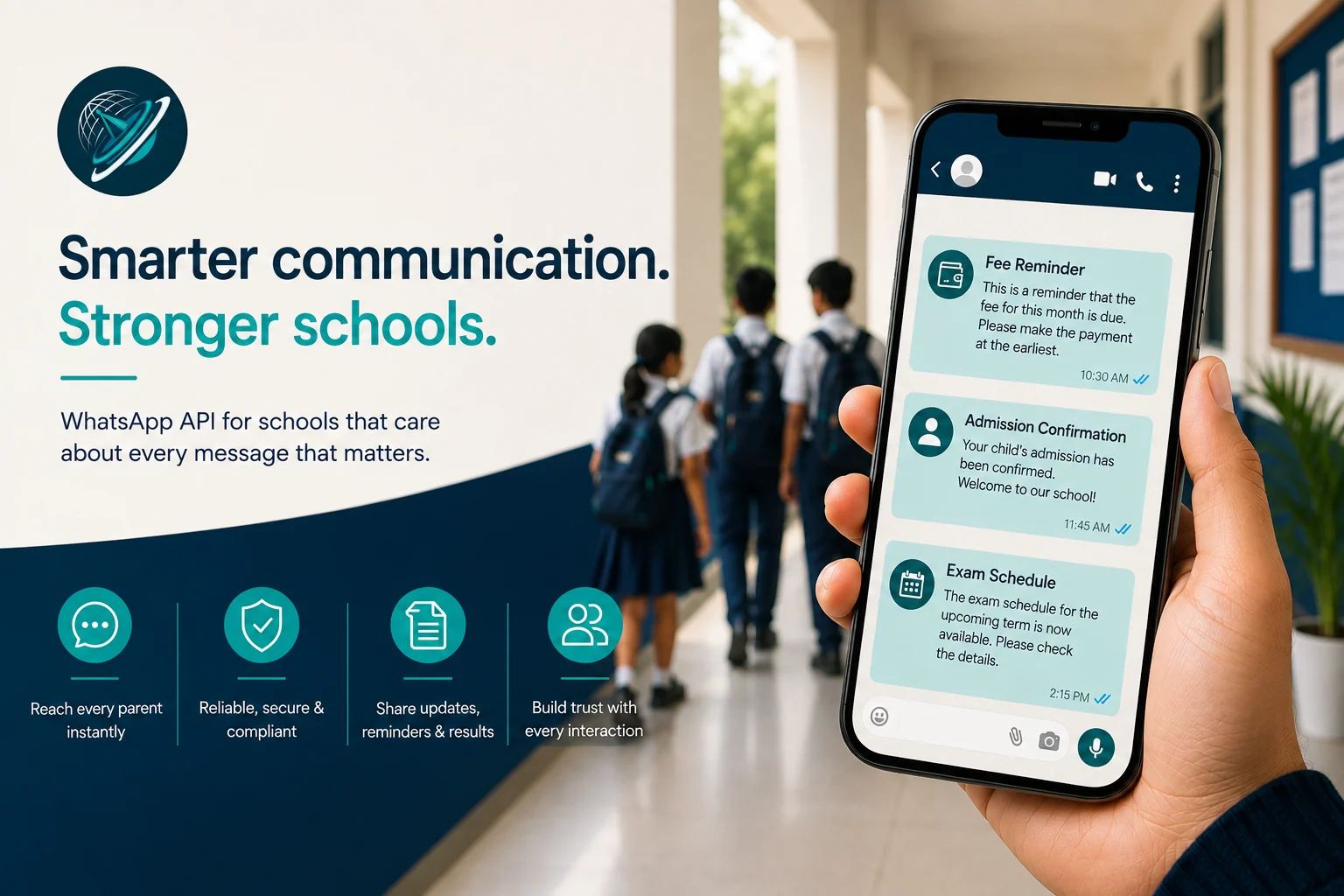
Every institution runs on messages that have to land on time. Fees fall due on a date. Admissions close on a date. An exam is rescheduled, a bus is delayed, a result is published — and several thousand parents need to know within the hour. Reaching all of them at once, reliably, is the operational problem sitting underneath almost everything an administration does. This guide compares the best WhatsApp API providers for education in India on what they actually cost.
So WhatsApp has quietly become the default channel for Indian education. Parents already have it open. As a result, messages get read rather than buried in an inbox, a marksheet can be attached, and a parent can reply — which SMS never allowed. What started as informal class groups run from a teacher's personal number is now a formal channel, and the WhatsApp Business API is how an institution runs it properly: approved templates, one verified number, and a record of what went to whom.
Choosing a provider for it is where most institutions get poor advice. A generic “best WhatsApp API” list ranks vendors on their per-message rate, which is the number every vendor prints in large type. However, it is rarely the number that decides your bill. Most platforms also charge a monthly subscription of ₹1,500 to ₹3,799, payable whether you send one message or fifty thousand. Add that to the per-message rate and the ranking changes completely.
We are one of the providers compared below, so read this with that in mind. What makes it checkable is that every rate quoted comes from the provider's own published pricing page, dated and linked. You can verify any figure here in about a minute.
For most Indian schools and coaching institutes, the cheapest WhatsApp Business API is the one with nothing to pay before you send. UDO charges ₹0 setup, ₹0 platform fee and ₹0 monthly subscription — only ₹0.98 per delivered marketing message and ₹0.30 for utility and authentication, with nothing charged for a message that fails to deliver. AiSensy adds ₹1,500 a month and Interakt ₹2,799, charged whether you send anything or not. Twilio and 360dialog suit Indian institutions poorly, because neither supports DLT for the SMS side you will also need.
- Compare the total monthly bill, not the headline rate. A per-message rate quoted without the platform fee beside it tells you almost nothing about what you will actually pay.
- A subscription is charged before you send anything. ₹1,500 a month at AiSensy is ₹18,000 a year; Interakt’s ₹2,799 is ₹33,588 — payable in the months your campus is closed too.
- UDO is lower on both halves of the bill. ₹0 monthly against ₹1,500 to ₹3,799, and ₹0.98 per delivered message against AiSensy’s ₹1.09.
- Ask whether you pay for undelivered messages. Parent phone numbers go stale constantly. At 90% delivery, sent-based billing costs about 11% more per message that actually arrives.
- WhatsApp does not use DLT. SMS does. Most articles conflate the two. You will run both channels, so you need a provider that handles Meta template approval and DLT registration.
- All rates exclude 18% GST, and every provider here bills Meta's conversation charges on top.
What schools send, and why it changes the provider you pick
First, be honest about your message mix before comparing WhatsApp API providers for education. This is the single input that decides which pricing model suits you, and it is the step almost every institution skips.
Fee reminders
Due-date notices, instalment reminders, overdue follow-ups and payment confirmations. Utility templates, sent monthly or quarterly to every parent on your roll.
Admission enquiries
Acknowledging a form fill, chasing missing documents, confirming an interaction slot, announcing a result. Seasonal, high-intent, and the one place a fast reply changes the outcome. See our guide to WhatsApp lead generation and enrolment.
Daily operations
Absence alerts, holiday notices, PTM scheduling, exam timetables, transport delays. Low value individually, enormous in aggregate — and the bulk of your monthly count.
Results and reports
Marksheets, progress reports, attendance summaries. Often a document attachment, which WhatsApp handles natively and SMS cannot.
Multiply your student count by the number of messages each family receives in a month. A 600-student school sending eight messages per family lands near 4,800 utility messages. A 4,000-student university on the same cadence lands near 32,000. Those two institutions should not choose the same provider, and the table below shows why.
WhatsApp API providers for education, compared
These are the WhatsApp API providers for education that most Indian institutions shortlist. Rates below were read from each provider's published pricing page on 22 August 2026. Meta's own conversation charges apply on top for every provider without exception, and all figures exclude 18% GST.
| Provider | Monthly fee | Marketing | Monthly bill fee + per message |
|---|---|---|---|
| UDO | ₹0 | ₹0.98 | ₹0 + ₹0.98 |
| AiSensy Basic | ₹1,500 | ₹1.09 | ₹1,500 + ₹1.09 |
| AiSensy Pro | ₹3,200 | ₹1.09 | ₹3,200 + ₹1.09 |
| Interakt Growth | ₹2,799 | ₹0.958 | ₹2,799 + ₹0.958 |
| Interakt Advanced | ₹3,799 | ₹0.949 | ₹3,799 + ₹0.949 |
| Wati | Subscription | Rate card | Subscription + rate card |
| Twilio | Custom | ₹1.20+ | Custom + ₹1.20+ |
| 360dialog | €49+ | Rate card | €49+ + rate card |
Sources, all read 22 August 2026: UDO WhatsApp pricing, AiSensy, Interakt, Wati. Wati publishes its India plan tiers without INR figures on the page, so we have not invented one. UDO bills on delivered messages only; no other provider here states a billing basis. Excludes 18% GST. Meta conversation charges apply separately for all.
Three costs decide your real bill and none of them appear in the table above. Undelivered messages. Parent numbers go stale between admission and the next fee cycle, so if you are billed on messages sent rather than delivered you pay for every failure — UDO bills only on messages that arrive. DLT registration. Every Indian institution runs SMS alongside WhatsApp, and a provider who cannot handle DLT leaves you managing two vendors and two compliance processes — UDO handles it as part of onboarding. Plan tiers and agent seats. Ask what happens when your admissions desk staffs up for the season, and whether a busier month pushes you onto a higher plan. With no subscription and no tier to climb, that question never arises with UDO.
What WhatsApp API providers for education actually cost
A monthly platform fee never moves, so you pay it in full whether you use it or not. A per-message rate, on the other hand, scales with what you actually send. So the WhatsApp API providers for education split into two camps here. Here is the same volume priced three ways, using each provider’s published rate and monthly fee together.
| Messages / month | UDO ₹0 + ₹0.98 |
AiSensy Basic ₹1,500 + ₹1.09 |
Interakt Growth ₹2,799 + ₹0.958 |
|---|---|---|---|
| 2,000 — small coaching centre | ₹1,960 | ₹3,680 | ₹4,715 |
| 5,000 — 600-student school | ₹4,900 | ₹6,950 | ₹7,589 |
| 10,000 — 1,200-student school | ₹9,800 | ₹12,400 | ₹12,379 |
| 20,000 — large school group | ₹19,600 | ₹23,300 | ₹21,959 |
| 50,000 — university | ₹49,000 | ₹56,000 | ₹50,699 |
Cheapest in each row shown in bold. Calculated from the published rates in the table above. Meta charges the same conversation fee whichever provider you buy through, so this excludes it, and 18% GST as well.
What WhatsApp API providers for education charge before a single message
A platform fee lands every month of the year, including the ones when your campus is shut. Here is what it adds before you send anything at all.
Parent contact databases decay faster than almost any other list — numbers change between admission and the next fee cycle. If you are billed on messages sent rather than delivered, a 90% delivery rate means you pay about 11% more per message that actually reaches a parent than the quoted rate suggests. Of the providers above, only UDO publishes a delivered-only billing commitment. So ask the others directly, and get the answer in writing.
Admission messages for parents: ready-to-send templates
An admission open message for school parents, an enquiry acknowledgement, a document chase — these are what an admissions desk sends on repeat. Each one below uses a utility template with variable placeholders in Meta's {{n}} format, so they can be submitted for approval as-is. Still, keep them factual — Meta classifies any template that reads like an advertisement as marketing, and prices it accordingly.
- Admission open announcement. “Dear Parent, admissions for the {{1}} academic session at {{2}} are now open for Classes {{3}}. Applications close on {{4}}. Apply here: {{5}}”
- Enquiry acknowledgement. “Thank you for your interest in {{1}}. We have received your enquiry for {{2}} in Class {{3}}. Our admissions team will call you on {{4}}. Reference number: {{5}}”
- Application received. “Dear {{1}}, your application for {{2}} has been received. Application number {{3}}. Track the status here: {{4}}”
- Documents pending. “Dear {{1}}, your application {{2}} is on hold pending these documents: {{3}}. Please submit by {{4}} to avoid delay.”
- Interaction scheduled. “Dear {{1}}, the admission interaction for {{2}} is scheduled on {{3}} at {{4}}. Venue: {{5}}. Please carry the original documents.”
- Admission confirmed. “Congratulations. {{1}} has been granted admission to Class {{2}} at {{3}} for the {{4}} session. Please complete the fee formalities by {{5}} to confirm the seat.”
- Waitlist update. “Dear {{1}}, application {{2}} is currently waitlisted at position {{3}}. We will contact you if a seat becomes available before {{4}}.”
“Admissions are open, apply now, limited seats” is promotional and will be approved as a marketing template, which costs ₹0.98 per delivered message with UDO. The same information written as a factual notice with a date and a link is a utility template at ₹0.30. On 5,000 messages that is ₹3,400 a month saved for identical content.
Sending a fees message to parents: reminder templates
A fees message to parents is the highest-value message a school sends, because the read rate is far above email and the parent can pay from the same thread. So escalate in stages, rather than sending one message on the due date.
- Seven days before due. “Dear Parent, the {{1}} term fee of ₹{{2}} for {{3}} (Class {{4}}) is due on {{5}}. Pay online: {{6}}”
- Due today. “Dear Parent, the fee of ₹{{1}} for {{2}} is due today, {{3}}. Pay here to avoid a late fee: {{4}}”
- Overdue notice. “Dear Parent, the {{1}} fee of ₹{{2}} for {{3}} was due on {{4}} and remains outstanding. A late fee of ₹{{5}} applies from {{6}}. Pay now: {{7}}”
- Instalment reminder. “Dear Parent, instalment {{1}} of {{2}}, amounting to ₹{{3}} for {{4}}, is due on {{5}}. Balance after this payment: ₹{{6}}”
- Payment received. “Received ₹{{1}} towards the {{2}} fee for {{3}} on {{4}}. Receipt number {{5}}. Thank you.”
- Partial payment. “Received ₹{{1}} towards the {{2}} fee for {{3}}. Outstanding balance: ₹{{4}}, due by {{5}}.”
First, always name the student and the class. A parent with three children at the same school cannot act on “your fee is due”, and an ambiguous reminder generates a phone call — which is the cost the message existed to avoid.
Template approval and DLT: what WhatsApp API providers for education must handle
Most WhatsApp API providers for education gloss over this, and it is easily the most common error in articles on the subject, and getting it wrong will cost you a week during admission season. Entirely separate regimes govern WhatsApp and SMS, and a school running both needs both.
Meta template approval
- Governed by Meta, not TRAI. DLT does not apply.
- Each template is submitted and approved individually
- Approval usually lands within minutes to a few hours
- Category — utility or marketing — is assigned by Meta and sets your price
- Requires a verified Meta Business account and a dedicated number
DLT registration
- Mandated by TRAI under TCCCPR. Applies to every SMS sender
- Three separate registrations: principal entity, sender ID, content template
- Allow one to two weeks, longer during peak season
- Applies whichever provider you buy from — it is not a vendor policy
- Still necessary: SMS reaches parents without smartphones or data
Twilio and 360dialog are competent WhatsApp providers, but neither supports Indian DLT registration for the SMS channel. But an Indian institution will always need SMS for the families WhatsApp does not reach, so choosing either means running two vendors and two compliance processes. In other words, for a school office that is the real cost, not the rate card.
Which WhatsApp API providers for education fit your institution
In short, there is no single best provider among the WhatsApp API providers for education in India. There is a best provider for your student count, your message mix and your team size. So match yourself to one of these three.
Built for bulk sending — at whatever scale your institution needs
Five hundred parents or fifty thousand — there is no plan tier to climb, no agent seats to buy and no subscription to renew as your roll grows. Our published rate is simply the lower one at the volumes a school actually sends, and the table above shows the arithmetic instead of asking you to take it on trust. So tell us your real annual volume, and we will quote against it — then compare that quote with any other WhatsApp API providers for education you are considering.
Frequently asked questions
Among the WhatsApp API providers for education in India, the deciding factor for most schools and coaching institutes is whether the provider charges a monthly platform fee. UDO charges ₹0 setup, ₹0 platform fee and ₹0 monthly subscription, billing ₹0.98 per delivered marketing message and ₹0.30 for utility and authentication. AiSensy adds ₹1,500 a month and Interakt ₹2,799, charged whether you send anything or not. Twilio and 360dialog are poor fits for Indian institutions because neither supports DLT for the SMS channel you will also need.
A 600-student school sending around 5,000 messages a month pays about ₹4,900 with UDO at ₹0.98 per delivered message and no subscription, against ₹6,950 with AiSensy Basic and ₹7,589 with Interakt Growth once their monthly fees are counted. Utility messages such as fee reminders cost ₹0.30 with UDO. All exclude 18% GST and Meta's own conversation charges, which are identical whichever provider you use.
Fee reminders are utility, provided they are written as factual notices stating the amount, the student and the due date. With UDO a utility message costs ₹0.30 per delivered message against ₹0.98 for marketing, so the wording has a direct commercial effect. Adding promotional language to an otherwise transactional message can have Meta reclassify it as marketing and multiply the cost.
No. DLT is a TRAI requirement that applies to SMS only. Meta runs its own template approval process for WhatsApp, which is separate and usually completes within hours rather than the one to two weeks DLT can take. However, almost every Indian institution runs SMS alongside WhatsApp to reach families without smartphones, so you will need DLT registration for that channel regardless.
State the institution, the student or applicant name, the class or programme, the specific action required, and a deadline. An admission confirmation, for example, should name the student, the class granted, the session and the date by which fees must be paid to hold the seat. Vague messages generate phone calls to the office, which is the cost the message was meant to remove.
Yes, and this is WhatsApp's main advantage over SMS for education. When a parent replies, a 24-hour customer service window opens during which your team can respond freely, at no per-message charge until 30 September 2026 with every provider here. For admission enquiries in particular that turns a one-way notice into a conversation, which is where the enrolment actually happens.
No. Every rate quoted here excludes 18% GST, and Meta's own conversation charges apply on top for all providers. Because Meta's charges are identical whichever platform you buy through, they do not affect the comparison — but they do affect your budget, so include them before signing anything.
Run a small paid pilot against a real segment of your own parent database rather than a clean test list. One class or one batch is enough. Delivery rates and the true cost of stale numbers only surface against genuine contacts, and a pilot on curated data will tell you nothing useful about either.