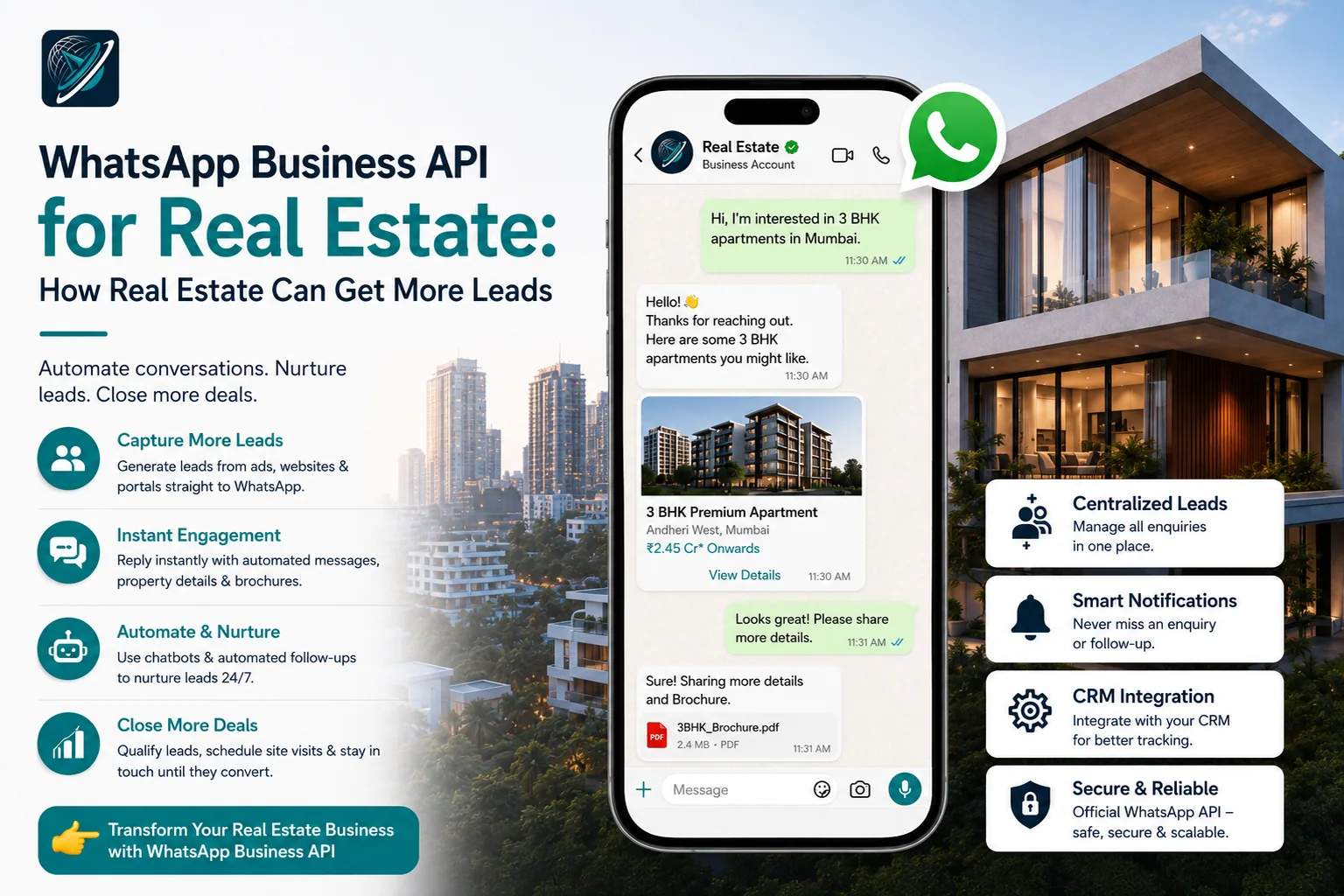
A real estate lead is expensive and perishable. You pay for it twice — once to the portal or the ad platform, and again in the salesperson-hours spent chasing it. Then most of it evaporates, not because the buyer was cold, but because nobody answered in the first ten minutes, or because the fourth follow-up never got sent.
WhatsApp Business API attacks both ends of that problem. At the front, it gives you channels that turn attention into an identified enquiry — Click-to-WhatsApp ads, QR codes on site boards and hoardings, a website widget, portal routing. At the back, it qualifies and follows up automatically, so the sales team inherits a described buyer instead of a phone number.
WhatsApp Business API for real estate lead generation works in two halves. Capture: Click-to-WhatsApp ads, QR codes on site boards, hoardings and print, a website widget, and automatic routing of portal enquiries all open a WhatsApp thread with an identified buyer. Convert: automation then asks the qualifying questions a salesperson would ask anyway — location, property type, budget, timeline — delivers the brochure, books the site visit and runs follow-ups for months without anyone remembering to.
- WhatsApp generates leads at the capture layer. Click-to-WhatsApp ads and QR codes create identified enquiries; the API is what makes them scale.
- A WhatsApp lead arrives with a name and a number attached. No form abandonment, no fake numbers, no waiting on an email that never gets opened.
- Qualification is the highest-value automation. Budget, location and timeline collected before the call changes every conversation after it.
- The property cycle is long. A buyer who asks for a brochure today may visit in six weeks — follow-up structure matters more than speed alone.
- Automate the repetition, not the relationship. Hand over to a human the moment real intent appears.
- CRM integration is where it compounds — without it you have fast replies and no memory.
- Measure cost per qualified lead and lead-to-visit rate, not messages sent. Those two predict revenue.
Why real estate leads leak faster than most
Because the sales cycle is long and conversational, and every gap in it is a place to lose someone. A prospect asks for a brochure today, wants pricing tomorrow, and is only ready for a site visit a fortnight later. Email goes unread and calls go unanswered — a property enquiry that reaches a call centre is competing with every other unknown number that buyer ignores. WhatsApp gets opened, and the thread keeps the whole history in one place.
Enquiries decay in a spreadsheet
Leads sit unanswered for hours. The same five questions get asked by phone. Brochures are shared manually. Follow-ups depend on a salesperson remembering — and after 40 enquiries, they don't.
Every enquiry is worked the same way
Instant acknowledgement, structured qualification, brochure on request, visit booking, and follow-ups that fire on schedule whether or not anyone remembers.
Practically, that means you can respond to enquiries in seconds, collect budget and location before a rep is involved, share approved project information, route qualified buyers to the right salesperson, schedule visits, and keep the full conversation history attached to the lead. For the wider picture of how this works across any sector, see our guide to automating WhatsApp lead generation.
Where real estate leads come from — and where they die
Before automating anything, it helps to be honest about which sources actually produce buyers and what each one costs you in lost time. Most Indian developers and brokers work some mix of these five.
| Source | What you get | Where it leaks | What WhatsApp changes |
|---|---|---|---|
| Property portals 99acres, MagicBricks, Housing |
High volume, mixed intent. The same buyer often enquires on four listings at once. | You are one of four callers. Whoever reaches them first, with something useful, wins. | An instant WhatsApp reply lands before the other three dial. The buyer reads it on their own time. |
| Click-to-WhatsApp ads Meta, Google |
An identified enquiry that opens a chat thread, not a form submission. | Nothing much — this is the strongest source, and it is underused. | This is the lead generation. The ad opens WhatsApp; automation qualifies from message one. |
| Site boards & hoardings | Genuinely local, high-intent buyers already standing near the project. | A phone number on a board gets photographed and forgotten. | A QR code opens WhatsApp with a pre-filled project name. Zero friction, and the source is tagged. |
| Your website | Self-qualified visitors who searched for you or the project by name. | Form abandonment. Buyers will not fill six fields on a phone. | A WhatsApp widget replaces the form. One tap, and you have a name and a real number. |
| Referrals & walk-ins | The highest conversion rate of anything on this list. | Never recorded anywhere. Lives in one salesperson's phone. | The thread sits in a shared inbox with the CRM record, so it survives the salesperson leaving. |
Five ways WhatsApp Business API generates real estate leads
“Lead generation” on WhatsApp is not one feature. It is five distinct entry points, each suited to a different part of how property actually gets sold in India. You do not need all five — most teams start with two.
Every one of these arrives with a verified mobile number and a name already attached, because that is how WhatsApp works. Compare that with a web form, where a meaningful share of submissions carry a fake number typed to get past the gate. A WhatsApp lead is contactable by definition — which is why cost per qualified lead usually falls even when cost per click does not.
| Entry point | Best for | How it works |
|---|---|---|
| Click-to-WhatsApp ads | New launches, inventory pushes, re-targeting | The ad’s call to action opens WhatsApp instead of a landing page. The first automated message qualifies before a rep sees it. |
| QR codes | Site boards, hoardings, print, expo stalls, brochures | Scanning opens a chat pre-filled with the project name, so you know which board produced which buyer. |
| Website widget or wa.me link | Project pages, price pages, contact pages | Replaces the enquiry form. One tap opens a thread; no fields to abandon. |
| Portal lead routing | Teams already paying for portal leads | Portal enquiries are pushed into WhatsApp automatically, so the first response goes out in seconds rather than hours. |
| Missed-call or IVR handoff | Print, radio and outdoor campaigns using a phone number | A missed call to a published number triggers a WhatsApp message back, converting a call into a threaded conversation. |
Two of these — Click-to-WhatsApp ads and QR codes — are genuine top-of-funnel acquisition. The other three convert demand you have already paid for into a conversation you can automate. Both matter, but they are budgeted differently, and it is worth being clear which is which before you measure anything.
How WhatsApp lead generation actually helps a real estate business
Every channel promises more leads. What matters for property is narrower than that, because the constraint in real estate is rarely lead volume — it is that a small sales team cannot work the volume it already buys, fast enough, for long enough. These are the eight places the return actually shows up.
Where the returns show up
Ordered by how quickly a developer or broker tends to notice them.
Three of those deserve expanding, because they are where the difference between a messaging channel and a lead generation system actually sits.
Speed, in a market that races. A buyer browsing a portal rarely enquires once. They tap four listings in a sitting, and four sales teams get the same notification. If your reply lands while the others are still in a dialler queue, you are not competing on price yet — you are the only conversation open. This is the single clearest gain, and it needs no automation cleverness at all, only that the first response is immediate.
Capacity that does not need headcount. A launch weekend or a well-funded campaign produces enquiry volume no team can work by hand. The usual outcome is that the first eighty leads get called properly and the rest decay in a spreadsheet — you have paid for all of them. Automation makes the four-hundredth enquiry get the same acknowledgement, the same qualifying questions and the same follow-up schedule as the first.
Attribution you can actually spend against. Most developers cannot say which hoarding, which portal or which campaign produced the buyers who signed. When every entry point carries its own tag, that becomes a report rather than an argument — and the next quarter’s budget stops being a guess.
Qualification is what changes the economics
Speed wins you the conversation, but qualification is what makes the sales team profitable. When location, property type, budget and timeline are captured before anyone picks up the phone, your reps stop spending their day discovering that a caller wanted a different city or a budget you do not serve.
The same headcount covers more genuine buyers, and cost per qualified lead falls even when cost per click does not. That is the number worth taking to a budget meeting.
Where WhatsApp sits in the real estate funnel
The full journey, and the point of each stage:
Lead source → WhatsApp response → qualification → property recommendation → brochure and pricing → site visit → sales follow-up → conversion. The goal is never to automate the whole thing — it is to automate the repetitive middle so your team spends its hours on buyers who are ready.
What happens after the lead lands
Capture is half the job. These ten workflows are what turn a captured enquiry into a booked site visit, ordered roughly by how quickly each one pays for itself.
Instant response to new enquiries
A new enquiry triggers an immediate WhatsApp reply that acknowledges the request and offers the obvious next steps — brochure, pricing, or book a visit.
In a market where the first responder usually wins the conversation, the gap between enquiry and reply is the whole game.
Automated lead qualification
Collect what your sales team would ask anyway: preferred location, property type, budget range, purchase timeline, and whether it is for personal use or investment.
Property brochure delivery
Prospects who ask for a brochure receive it immediately, in the thread, with the approved project information attached. No waiting for someone to find the right PDF and forward it.
For a sales team fielding dozens of enquiries a week, this alone recovers hours.
Property recommendations
Use the requirements already captured to point prospects at inventory that actually fits, rather than sending the full catalogue and hoping.
Someone who said 3BHK, Gurgaon, ₹1–2Cr, ready to move should not receive an under-construction studio in another city.
Site-visit scheduling
Collect a preferred date and time, confirm it back to the prospect, and notify the salesperson covering that project — all inside the same conversation.
Automated follow-ups
Property decisions take weeks. Without structure, follow-up depends on memory — and memory fails at volume.
- Brochure sent, no reply: a check-in after three days.
- Pricing shared: an offer to answer questions or arrange a visit.
- Visit booked: a reminder the day before.
- Visit completed: a follow-up while the property is still fresh.
Each one references what actually happened. A generic nudge reads as a broadcast and is treated like one.
The Workflow Is The Easy Part. The Plumbing Isn’t.
New project and launch communication
Announce launches, price revisions and remaining inventory to audiences who opted in — using approved templates and respecting messaging rules.
Segment it. A buyer who enquired about commercial space does not want a residential launch.
Re-engaging older leads
Real estate databases are full of prospects who were not ready six months ago and are now. A structured re-engagement journey — subject to consent and messaging rules — often outperforms new acquisition on cost per site visit.
Sales team coordination
Assign leads by project, location or language. Give managers visibility into which conversations are live, which have stalled, and who is responding. Conversations stop living on individual phones.
CRM integration
Push conversations, qualification answers and visit bookings into your CRM so the lead record carries its own history. Sales opens a call knowing the story; marketing finally sees which source produces buyers rather than enquiries.
What should a real estate business look for in a provider?
Compare on the capabilities that touch your sales workflow, not on feature-count. The two highlighted rows are the ones that decide whether this becomes a system or stays a chat app.
| Factor | Why it matters for property sales |
|---|---|
| Platform access | Official WhatsApp Business Platform access is the base requirement for anything scalable. |
| Automation depth | Decides whether qualification, brochure delivery and follow-ups run without a person. |
| CRM integration | Connects conversations to lead records. Without it, nothing compounds. |
| Team management | Essential once several reps handle enquiries across projects. |
| Interactive messaging | Buttons and lists make brochure / pricing / visit choices a single tap. |
| Campaign management | Launches, price revisions and re-engagement to opted-in audiences. |
| Analytics | Shows which projects and sources generate site visits, not just enquiries. |
| Scalability | Lead volume spikes hard at launch. The platform has to absorb it. |
| Support | Matters most during onboarding, verification and CRM integration. |
| Pricing transparency | You need the full cost — Meta charges plus platform fees — to judge cost per site visit. |
Already shortlisting? Our comparison of WhatsApp API providers in India covers the commercial side in detail.
WhatsApp Business App or the API?
The free app is genuinely fine for a small team having straightforward conversations. The question is when you outgrow it.
| Capability | Business App | Business API |
|---|---|---|
| Basic conversations | Yes | Yes |
| Automation | Limited | Advanced |
| CRM integration | Limited | Yes |
| Structured workflows | Limited | Yes |
| Larger sales teams | Less suitable | Built for it |
| Advanced integrations | Limited | Yes |
| Reporting | Basic | Provider-dependent |
The practical trigger is usually a second salesperson, or the first time a lead is lost because nobody followed up.
A new project launch, end to end
A developer launches a residential project. A prospect clicks the ad. Here is the whole path:
Seven steps, one conversation
No forms, no callback queue, no re-asking questions the buyer already answered.
What changes by business type
The workflows differ depending on what you sell and how long the decision takes.
| Business type | Workflows that matter most |
|---|---|
| Developers | Project enquiries, brochure delivery, qualification, site visits, launch communication, follow-ups. |
| Brokers | Enquiry handling, requirement collection, property matching, viewing appointments. |
| Consultants | Qualification, follow-up reminders, document sharing, agent handoff. |
| Commercial | Requirement collection, property information, meeting scheduling, lead routing. |
| Luxury | High-intent enquiry handling, personalised information, appointment coordination, relationship management. |
| Rentals | Availability enquiries, viewing appointments, follow-ups on shortlisted units. |
How to build the workflow
In order. Skipping straight to automation is why most of these projects stall.
- Map your lead sources and what information each one already provides.
- List the questions your reps repeat on every first call — those are your automation candidates.
- Define qualification criteria: location, property type, budget, timeline.
- Decide the handover point — where automation stops and a person starts.
- Prepare approved templates for business-initiated messages.
- Connect the CRM or lead-management system.
- Set assignment and escalation rules so no lead sits unclaimed.
- Track the metrics below — especially lead-to-site-visit rate.
What should real estate teams measure?
Messages sent tells you nothing. These nine tell you whether WhatsApp is generating leads and turning them into site visits.
| Metric | What it tells you | Watch for |
|---|---|---|
| Qualified leads by source | Which board, ad or portal actually produces buyers | Tag every entry point, or you are guessing |
| Response rate | How many prospects reply at all | A weak opening message |
| Qualified leads | How many meet your criteria | Ad targeting pulling the wrong buyers |
| Site-visit requests | How many move toward a visit | The number that predicts revenue |
| Follow-up response | Whether later messages land | Generic, non-contextual nudges |
| Lead-to-visit rate | How efficiently enquiries become visits | Where the funnel actually leaks |
| Visit-to-booking rate | How well visits convert | A site or pitch problem, not a message problem |
| Cost per qualified lead | Spend per meaningful prospect | Cheap leads that never qualify |
| Conversion rate | Leads reaching your defined outcome | Good leads lost at handover |
If you track only one, track lead-to-site-visit rate. Everything upstream exists to move that number.
Compliance, briefly
Design around WhatsApp Business Platform policies, genuine consent and template requirements. Keep messages relevant and avoid claims you cannot support — property advertising is scrutinised. Message categories, template rules and pricing change: verify against current Meta documentation and your provider's terms before launching a campaign.
WhatsApp as a sales system, not a bulk channel
We help property businesses build WhatsApp Business API workflows around how their sales team actually works — automation for repetitive communication, lead and follow-up journeys, campaign management, plus outbound dialer, retry campaigns, payment-gateway recharge and reporting.
Pricing is campaign-based with ₹0 setup fee and ₹0 monthly subscription, so you evaluate cost against campaign requirements rather than committing to a platform rental. Current rates are on our pricing page.
A lead generation system, not a messaging channel
Treated as a chat app, WhatsApp is a faster way to answer people. Treated properly — ads and QR codes feeding it at the front, qualification and follow-up automation behind it, your CRM underneath — WhatsApp Business API becomes the system that carries a real estate lead from first attention to booked site visit. What the right setup looks like depends on your team size, lead volume, CRM and how much you genuinely want automated. Evaluate platform capability, integrations, support, reporting and total cost — in that order.
Frequently asked questions
It lets eligible businesses connect WhatsApp to their own systems and workflows. Real estate companies use it to capture enquiries from Click-to-WhatsApp ads, QR codes and portals, qualify buyers on budget and location, share brochures, book site visits and run follow-up sequences without a salesperson typing every reply.
Through five entry points: Click-to-WhatsApp ads that open a chat instead of a landing page, QR codes on site boards, hoardings and print, a website widget that replaces the enquiry form, automatic routing of property portal enquiries, and missed-call handoff from print or outdoor campaigns. Each one opens a thread with a verified mobile number already attached.
They are more contactable. A WhatsApp lead arrives with a working number and a name because that is how the platform works, whereas web forms attract abandonment and fake numbers typed to get past the gate. Intent still varies by source, so cost per qualified lead is the number to compare, not cost per lead.
Yes. Follow-up journeys can be triggered by enquiry stage - brochure sent, pricing requested, site visit booked, visit completed - subject to WhatsApp's messaging policies, template approval and customer consent.
Yes. Approved project information, PDFs, images and video can be delivered through supported message formats, so a prospect who asks for a brochure receives it immediately instead of waiting for a salesperson.
Yes. A workflow can collect a preferred date and time, confirm the request back to the prospect, and notify the sales representative covering that project - all before anyone picks up the phone.
Yes. Conversations, lead details and qualification answers can be pushed into your CRM through APIs or provider-supported integrations, so the sales team sees the full history against the lead record.
The free Business App suits a small team handling conversations manually on one number. The API supports automation, CRM integration, multiple agents, interactive messages and structured workflows - which is what a growing sales team needs.
Compare platform access, automation depth, CRM integration, team management, interactive messaging, campaign tools, analytics, support quality, scalability and pricing transparency. For real estate specifically, weight CRM integration and lead routing heavily.
Yes. Brokers use it for enquiry handling, collecting buyer requirements, sharing matching properties, coordinating viewings and staying in touch with buyers whose purchase is months away.
Total cost combines Meta's per-conversation charges with your provider's platform fees and any integration work. Unique Digital Outreach charges no setup fee and no monthly subscription - you pay for messages delivered. Compare the whole structure, not one line of it.