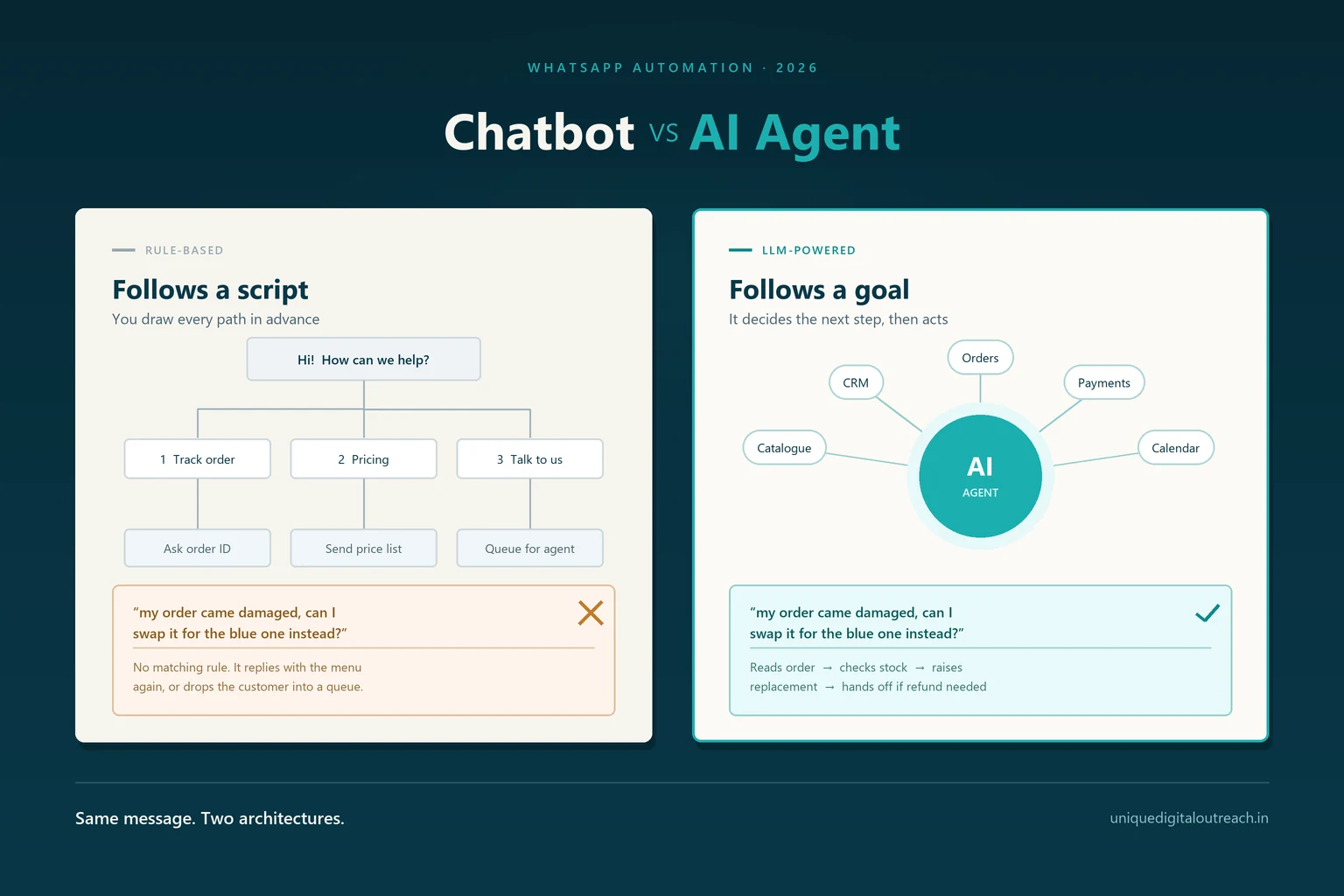
A WhatsApp chatbot is rule-based automation: you draw the conversation as a flow of menus, keywords and conditions, and it executes exactly that flow every time.
A WhatsApp AI agent is a language model connected to the same WhatsApp number, given a goal and access to your systems, that reads what the customer actually wrote and decides the next step itself.
Both sit on the WhatsApp Business API through an authorised Business Solution Provider. Both obey the same Meta messaging rules and the same per-message pricing. To the customer, both are just a business replying on WhatsApp.
Neither is the WhatsApp Business app’s away-message autoresponder, and neither is a way around Meta’s rules. Both need the API, an opted-in audience and approved templates. This guide is for businesses already on the API, or about to buy it, deciding what to put behind the number.
The choice matters anyway, because they fail in opposite directions. A chatbot is perfectly predictable and completely rigid. An agent is flexible and, without guardrails, occasionally confident about things that are not true.
We sell both. Where a chatbot is the right answer — and for a large share of Indian businesses it still is — this guide says so.
Quick summary: WhatsApp chatbot or WhatsApp AI agent?
If you are short on time, match your situation to one of these five and stop reading.
Choose a WhatsApp chatbot when the conversation has a known set of endings, and an AI agent when it does not.
- Best for order status, OTP and FAQs: Rule-based chatbot — a script never invents an answer.
- Best for open-ended sales and support: AI agent — it handles what you did not anticipate.
- Best for a small business with no developer: Meta Business Agent — free, in the WhatsApp Business app.
- Best for regulated or high-value chats: Chatbot front door, human behind it.
- Best above ~2,000 chats a month: Hybrid — scripted flows for transactions, an agent for the rest.
Last verified 27 August 2026.
- Meta charges a scripted bot and a third-party AI agent identically. Every provider resells the same Meta rate, so switching vendor never changes that line — only your platform fee and your AI usage.
- The real question is not intelligence, it is variance. Count how many of last month’s inbound messages had an answer you could have written in advance. That percentage is your chatbot.
- An AI agent earns its keep on the remainder — the messy, off-script, multi-part questions a decision tree cannot hold.
- Meta Business Agent is now a real third option. Launched globally on 3 June 2026 after a pilot that included India, free to activate in the WhatsApp Business app, with paid tiers announced for later.
- Neither removes the human. The escalation rule is the most important thing you will configure, and the thing most deployments get wrong.
- Almost nobody should pick one. Deterministic flows in front, an agent behind them, a person behind that.
How we compared them
Everything below is drawn from two kinds of source, and each is named where it is used.
Unique Digital Outreach is a WhatsApp Business API provider. We build both scripted flows and AI agents for customers, so we have a commercial interest in you deploying something.
What we do not have is an interest in you deploying the wrong one — an AI agent that invents a refund policy generates support tickets, not renewals. Read the section on where AI agents fail before you decide anything.
WhatsApp chatbot vs AI agent: what is the difference?
| Dimension | Rule-based chatbot | AI agent (your own) | Meta Business Agent |
|---|---|---|---|
| How it decides | A keyword, menu choice or condition matches a branch you drew. | A language model reads the message and picks the next action. | Meta’s model, taught from your business content. |
| Off-script message | Falls through. Repeats the menu or queues a human. | Interprets it, or escalates on a rule you set. | Interprets it, transfers topics you flag. |
| Where it runs | Your BSP platform, on the Business API. | Your BSP platform plus a model provider. | Meta, in the app or on the Business Platform. |
| Setup effort | Hours to days, in a no-code flow builder. | Days to weeks: prompts, tools, testing, review. | Minutes. Point it at your chats and catalogue. |
| Changing an answer | Edit the node. Deterministic and instant. | Edit the knowledge source or prompt, then re-test. | Update the content it learns from. |
| Predictability | Total. Same input, same output, every time. | High with guardrails, never absolute. | Controlled by Meta, not by you. |
| Acts on your systems | Only where you wired an API call into the flow. | Yes, and it decides which tool to call and when. | Through Meta’s supported integrations. |
| Languages | One flow per language, written by you. | Handles code-mixed Hinglish natively. | Replies in the customer’s language. |
| Cost shape | Fixed. Platform fee only. | Variable. Platform fee plus AI usage per conversation. | Metered by Meta on token usage. |
| Who sets the message rate | Meta. Identical whichever provider you buy through. | Meta. Metered on tokens rather than per message. | |
Sources read 27 August 2026: Meta pricing reference, Cloud API send-messages guide, Meta Business Agent product page. AI usage cost depends on your model provider and average conversation length, so we publish the formula rather than a rate we cannot source.
1. What is a WhatsApp chatbot?
A WhatsApp chatbot is the deterministic front door: a flow. A customer sends a message, the flow matches it to a branch, and the conversation walks the path you drew until it reaches a leaf.
Modern builders make those branches rich — reply buttons, list menus, catalogue cards, an API call to fetch an order status — but the logic underneath is still a tree.
That rigidity is a feature, not an apology for one. When a customer asks where their parcel is, there is exactly one correct answer and it lives in your order system. You do not want a model deciding how to phrase a delivery date.
Chatbots are also the only honest option when the reply carries an obligation: a payment confirmation, an appointment slot, a policy number, a fee due date. The value of a script here is precisely that it cannot say anything you did not write.
Where a rule-based chatbot is genuinely the right call
- Finite answer sets. Order tracking, store timings, branch addresses, dispatch updates, appointment slots and document checklists.
- Regulated wording. BFSI, insurance and healthcare messages where compliance approved a specific sentence and only that sentence may go out.
- Qualification before a human. 4 questions that route a lead to the right team, which is a form rather than a conversation.
- Low volume. Under roughly 500 chats a month, an agent’s build cost rarely pays back against a good auto-reply and menu.
It is not that the bot answers badly. It is that it answers the wrong question confidently, or loops.
The tell is a rising share of conversations ending in “talk to agent” or in silence. If more than roughly a quarter of your chats fall out of the flow, the flow is no longer the constraint — the customer’s vocabulary is.
2. What is a WhatsApp AI agent?
A WhatsApp AI agent is goal-driven and tool-using: a language model attached to your WhatsApp number and given 3 things: a goal, a knowledge base and a set of tools.
The goal is what a good outcome looks like. The knowledge base is your catalogue, policies and past conversations. The tools are the API calls it is allowed to make — look up an order, check stock, hold a slot, raise a ticket, create a lead in the CRM.
The customer writes something. The model reads it, decides which tool it needs, calls it, reads the result, and either replies or calls another tool. That decision loop is the whole difference. A chatbot has one path per input; an agent composes a path per conversation.
The practical consequence in India is language. A customer typing “bhai order abhi tak nahi aaya, kal tak aa jayega kya” matches no keyword you would have thought to write. An agent reads it, pulls the order, and answers with the real date.
What an AI agent does that a chatbot cannot
It handles what you did not plan
Off-script questions, 2 questions in one message, corrections halfway through and code-mixed Hinglish all resolve, instead of falling through to a menu.
It remembers the thread
Context carries across the conversation and across days, so the customer does not restate their order number every time they come back.
It finishes tasks, not just replies
Given the right tools it books the slot, raises the replacement, applies the coupon and writes the outcome back to your CRM.
It escalates on judgement
A well-configured agent hands over on sentiment, on value, on topic and on its own uncertainty — not only when someone types the word “agent”.
An AI agent is not a chatbot with better English. It is a system that takes actions on your behalf. If it can issue a refund, it can issue a wrong refund. Everything an agent is allowed to do has to be something you are willing to have done automatically, at 2am, with nobody watching.
3. What is Meta Business Agent?
In June 2026 Meta made this a three-way choice.
Meta Business Agent is Meta’s own AI agent, announced at Conversations in London on 3 June 2026 and rolled out globally after a pilot period that included India. It runs in the WhatsApp Business app, on the WhatsApp Business Platform, and across Messenger, Instagram and Meta Business Suite.
According to Meta’s product page, it learns from your past WhatsApp conversations, your Facebook Page posts, your website, your product catalogue and price list, and documents you upload.
It answers questions about hours and location, explains products, recommends from the catalogue, handles queries about discounts, payment and shipping, and collects the details you need from a customer. You can instruct it to always transfer complex or sensitive topics to you, and it learns from how you answer them.
Setup is 3 steps inside the app: register the number, teach the agent from your chats and catalogue, then test it and switch it on.
Activation is free; usage is metered. Meta bills its own agent on token consumption rather than per message, in a single charge that covers both the AI processing and the delivery. Check the current rate against your expected conversation volume before assuming it undercuts a third-party agent.
Meta Business Agent: the trade-off
- No developer, no integration project and no build to get a working agent
- Free to activate, with setup measured in minutes rather than weeks
- Replies in the customer’s own language out of the box
- The same agent works across WhatsApp, Messenger and Instagram
- Meta operates the model, so there is nothing for you to host or tune
- Availability is gated by market and account eligibility, not switched on for everyone
- You control what it learns from, not how it reasons or what it will say
- Integrations are the ones Meta supports — your own systems may not be among them
- Metered on token consumption, so a chatty agent costs more than a terse one and the bill is harder to forecast
- It does not replace your broadcast, template and campaign stack, which still needs the Business API
Small and mid-sized businesses whose questions are genuinely about the catalogue, the price list and the shop — and who would rather start this week than scope a project. If your agent needs to read your ERP, honour your refund matrix or write to your CRM, you are building your own. Talk it through with us →
Which differences actually change the decision?
Most comparisons stop at “one of them is smarter”. These are the 6 that come up in a real procurement conversation.
Find out which conversations you actually get
Which Meta rules apply to both?
Neither option is a way around WhatsApp’s messaging rules, and a vendor who implies otherwise is selling you a ban. A chatbot and an AI agent live inside the same 4 constraints.
The 4 constraints, in order of how often they bite
- Opt-in is mandatory. You may only message users who have opted in to hear from you, whatever composes the message.
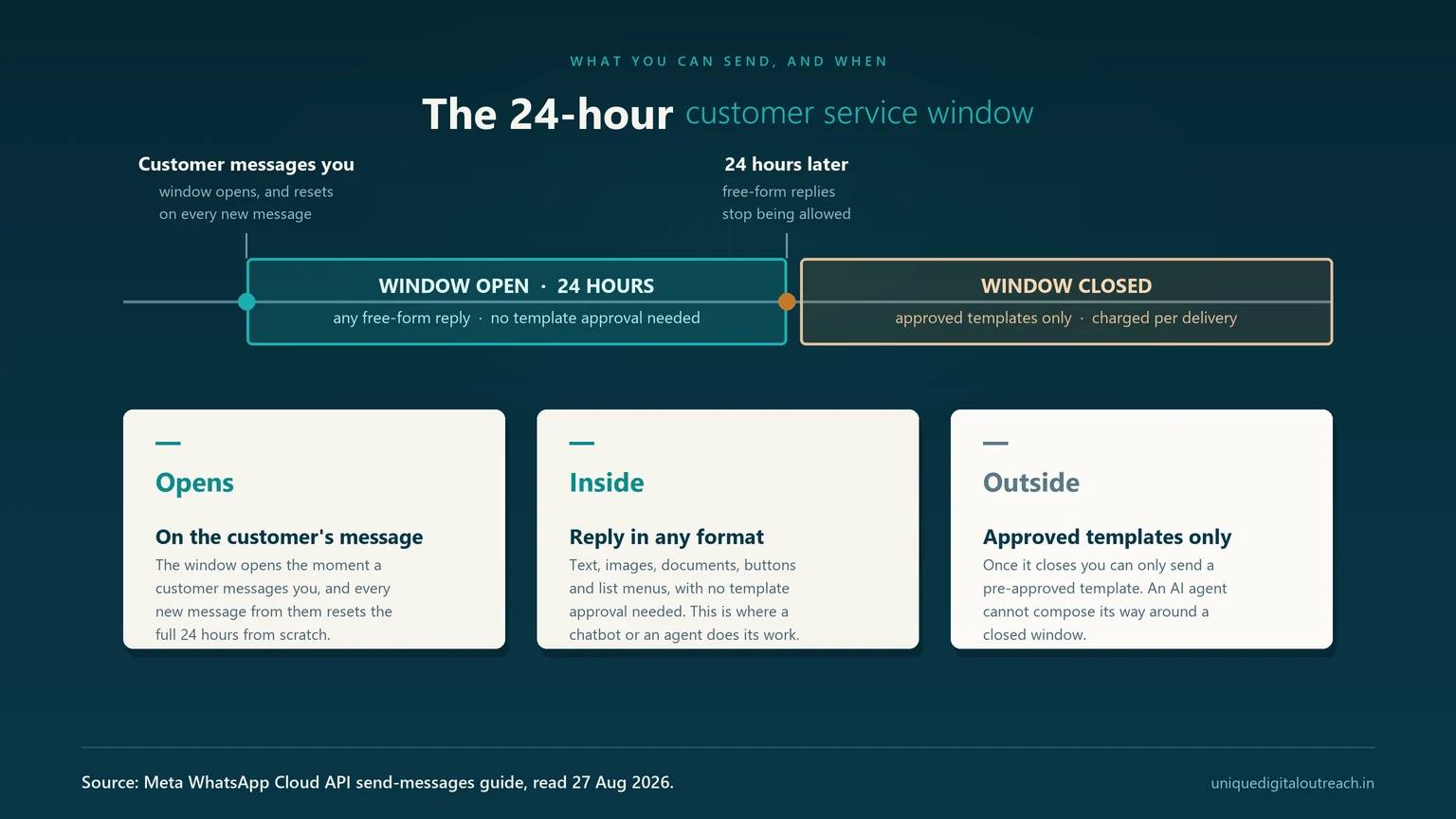
- The 24-hour customer service window governs free-form replies. According to Meta’s send-messages guide it opens when the user messages you and resets each time they message again. Inside it your automation can reply in any format; outside it, only an approved template may go out.
- Templates need approval, and they are categorised. Marketing, utility and authentication are approved and priced separately. An AI agent cannot invent a template to escape a closed window.
- Quality ratings and messaging limits apply to the number, not to the technology. Blocks and reports from annoyed customers degrade your rating whether a person, a script or a model annoyed them.
Meta publishes guidance for people receiving messages from businesses that use AI, and expects businesses to be straightforward about it.
Say so in the first reply. A single line — “You are chatting with our assistant; type agent for a person” — costs nothing, meets the expectation, and measurably reduces the frustration that produces blocks.
Where do WhatsApp AI agents fail?
Every failure below is one we have seen in a live deployment, and every one is preventable at design time rather than after launch.
4 failure modes, all preventable at design time
Confident wrong answers
An agent with a stale or thin knowledge base fills the gap rather than admitting it. The fix is grounding: answer only from retrieved sources, and say “let me check” when there is nothing to retrieve.
Escalation that never fires
The commonest and costliest failure. An agent that only hands over on the word “agent” will hold on to an angry customer for 11 turns. Escalate on sentiment, value, repeated failure and topic.
Too much permission
Tools that write — refunds, cancellations, discounts, address changes — need value ceilings and confirmations. Read-only tools are safe; write tools are a policy decision, not a technical one.
Nobody reads the transcripts
An agent nobody audits drifts quietly. Sample 50 conversations a week for the first 60 days. That first month of transcripts is the most useful product research you will get all year.
Which one should you choose?
Run one exercise before you decide anything. Export last month’s inbound WhatsApp messages, take a sample of 200, and sort each into “I could have scripted this answer” or “I could not”. The ratio is your answer, and the exercise takes an afternoon.
The two-hundred-message test
- Most inbound messages have one correct, checkable answer
- Your conversations are transactional — status, slots, documents, payments
- Compliance approved specific wording and it must go out unchanged
- You are under roughly 500 chats a month
- You need it live this week
- Nobody on the team can own reviewing transcripts yet
- A meaningful share of chats fall out of your current flow
- Customers write in Hinglish, or ask two things at once
- Pre-sales questions are open-ended and your catalogue is large
- Your team answers the same nuanced question in 50 different ways
- The systems it would need to read already have APIs
- Someone will own the escalation rules and the weekly transcript review
Can you run a chatbot and an AI agent together?
Nearly every deployment that survives contact with real customers ends up in the same shape, and it is worth designing for on day one rather than arriving at it after 2 rebuilds.
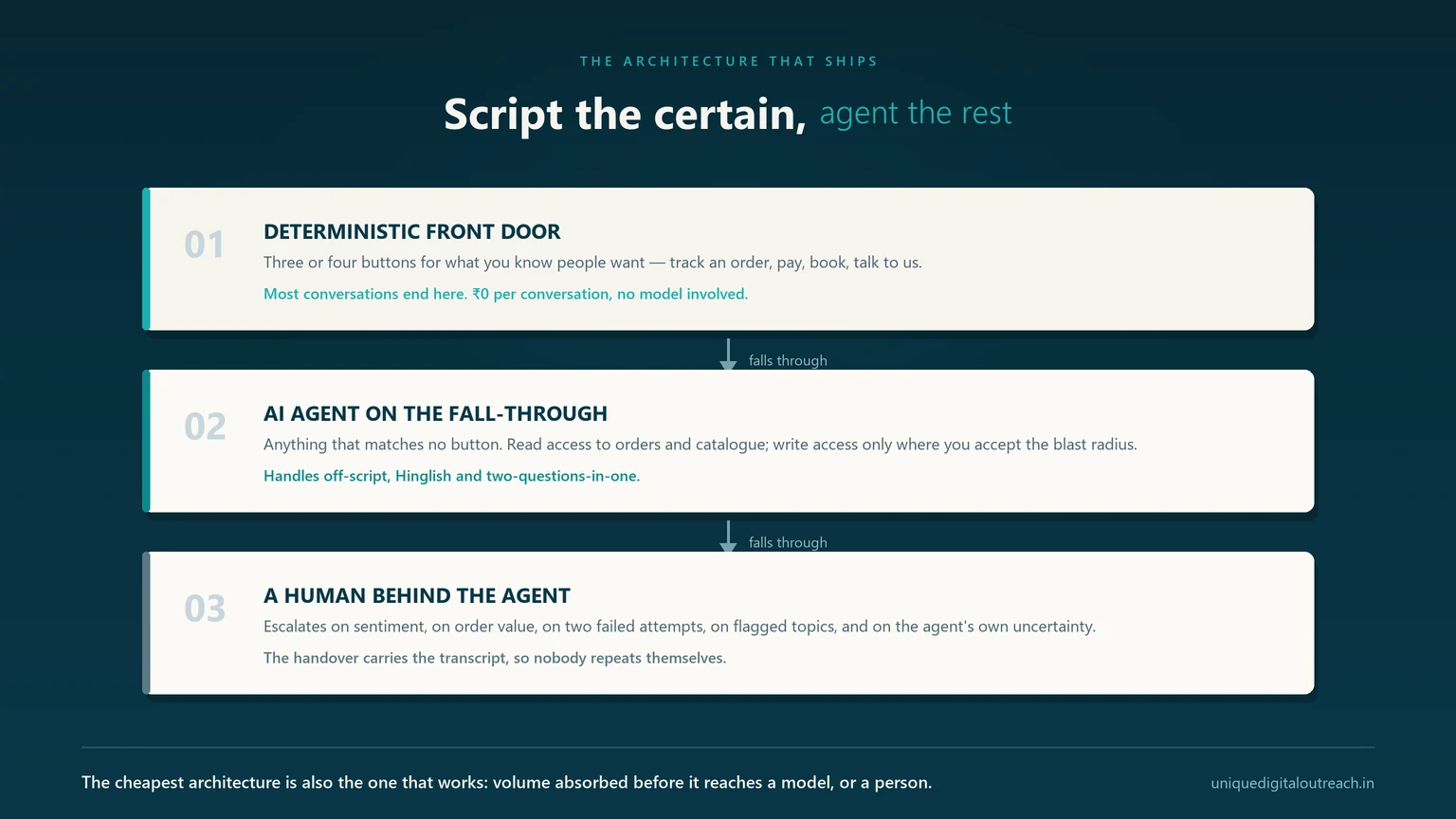
3 layers, front to back
A deterministic front door. The first message offers 3 or 4 buttons for the things you know people want — track an order, pay, book, talk to us. Most conversations end here, cheaply and predictably, with no model involved.
An agent behind the fall-through. Anything that does not match a button goes to the agent, with read access to orders and catalogue, and write access only where you have decided the blast radius is acceptable.
A human behind the agent. Escalation on sentiment, on order value above a threshold, on 2 failed attempts, on any topic you flagged, and on the agent’s own uncertainty. The handover carries the full transcript, so the customer never repeats themselves.
This is also the cheapest architecture, which is not a coincidence. The scripted path costs nothing per conversation and absorbs the majority of volume; the agent runs only on the residue that would otherwise have reached a person.
How UDO builds this
Unique Digital Outreach is a Meta Business Partner, and everything described here runs on the official WhatsApp Business API — not an unofficial wrapper or a browser automation of the kind that gets numbers banned. We serve businesses worldwide, not only in India.
Both the flow builder and the agent layer sit on the same number and the same account. In practice that means you are not choosing a vendor per architecture: you can start scripted and add the agent behind it later without migrating a verified number or re-approving templates.
- Meta Business Partner — an authorised route to the API, verifiable on Meta’s own partner directory rather than asserted on a website.
- Powered by the official WhatsApp Business API — approved templates, a verified business profile and Meta’s own delivery receipts, with none of the ban risk that comes with unofficial tooling.
- Worldwide sending — India and international destinations from one account, one balance and one invoice, without a second vendor for the rest of your market.
- One number, both architectures — scripted flows and the AI agent on the same verified number, so adding one later costs you no migration.
What you get, concretely
We will not put an AI agent in front of your customers without escalation rules you have personally read and approved. It is the single configuration that decides whether the deployment saves your team time or generates a new category of complaint.
It is not really a technical decision — it is a decision about what your business is willing to say automatically.
Where do these facts come from?
Every rule, date and rate stated above traces to one of the following. All were read on 27 August 2026; Meta changes messaging policy and pricing without notice, so re-check before relying on any of it.
6 primary sources, all read on 27 August 2026
- Meta — WhatsApp Cloud API overview — what the platform is, message types, webhooks and templates. developers.facebook.com.
- Meta — WhatsApp Business Platform pricing — how Meta charges per delivered template message, the template categories, and the free entry point window. developers.facebook.com.
- Meta — Cloud API send-messages guide — the 24-hour customer service window, what resets it, and free-form versus template messages. developers.facebook.com.
- WhatsApp Help Centre — using Meta Business Agent to chat with customers — Meta’s own description of the first-party agent. faq.whatsapp.com.
- WhatsApp for Business — Meta Business Agent product page — what it learns from, the three-step setup, human transfer and market availability. whatsappbusiness.com.
Frequently asked questions
A WhatsApp chatbot follows a script: keywords, menus and conditions route the customer down a branch you drew in advance, and it does the same thing every time. A WhatsApp AI agent is a language model given a goal, a knowledge base and a set of tools; it reads what the customer actually wrote, decides which action to take, calls your systems and then decides again. A chatbot has one path per input. An agent composes a path per conversation. Both run on the same WhatsApp Business API and obey the same Meta rules.
Sample 200 of last month’s inbound WhatsApp messages and sort them into answers you could have scripted in advance and answers you could not. If most are scriptable, build a chatbot; it is cheaper, faster and cannot say anything you did not write. If a large share are not, an AI agent will resolve conversations a decision tree would drop. Most businesses above roughly 2,000 chats a month end up running both: scripted flows for transactions, an agent for whatever falls through.
Meta’s charge is identical for a rule-based chatbot and a third-party AI agent, because both produce the same message categories. The difference is one extra line: AI usage, billed per conversation or per token by your model provider, which scales with conversation length rather than message count. A chatbot’s cost is fixed and forecastable; an agent’s is variable. Judge the agent against the support headcount it displaces rather than against your message bill.
Meta Business Agent is Meta’s own AI agent, announced on 3 June 2026 and rolled out globally after a pilot that included India. It runs in the WhatsApp Business app and on the WhatsApp Business Platform, learns from your past chats, catalogue, website and Facebook Page, and transfers topics you flag to a human. Activation is free and Meta meters its replies on token usage. You still need a Business Solution Provider for broadcast campaigns, template management, multi-agent inboxes and integration with your own systems, none of which Meta Business Agent replaces.
No. Outside the 24-hour customer service window, only pre-approved template messages can be sent, and marketing templates are approved and categorised by Meta before use. An AI agent cannot compose its way around a closed window or an unapproved template. It can decide which approved template to trigger and when, but the template itself, the opt-in and the category all remain under the same rules that apply to every other sender.
Meta publishes guidance for people chatting with businesses that use AI, and being straightforward about it is the expectation. Practically, disclose it in the first reply and give an obvious way out: one line saying they are chatting with an assistant and can type “agent” for a person. It costs nothing, it reduces the frustration that leads to blocks and reports, and blocks are what damage your number’s quality rating.
It changes what the team does rather than removing it. The agent absorbs repetitive and off-script volume; what reaches a person is fewer conversations but harder ones, plus a job nobody had before, which is reviewing transcripts and tuning escalation rules. Plan for at least one person owning that weekly. Deployments that fail are almost always the ones where nobody was made responsible for reading what the agent actually said.
A menu-driven chatbot on an approved WhatsApp Business API number can be live within days, because the work is drawing the flow. Meta Business Agent is faster still, quoted in minutes inside the WhatsApp Business app. A custom AI agent worth trusting takes a few weeks, and most of that goes on grounding it in your content, wiring its tools and agreeing the escalation rules rather than on the model. Number verification and template approval sit in front of all three.
Yes, and it is the architecture we recommend. Buttons and menus handle the predictable requests at no per-conversation cost, anything that does not match a button routes to the agent, and the agent escalates to a human on rules you set. One number, one verified business profile, one set of templates. Because both layers sit on the same account, you can start scripted and add the agent later without migrating the number or re-approving templates.
For informational and navigational conversations, with tight grounding and read-only tools, yes. For anything carrying an obligation — a policy quote, a claim decision, a clinical instruction, a payment confirmation — use approved templates and scripted flows, because the wording has been signed off and must go out unchanged. The usual split in regulated sectors is an agent for triage and explanation, and deterministic messages for anything the business will be held to.
The Unique Digital Outreach content team. We are a Gurugram-based CPaaS provider running WhatsApp Business API, Bulk SMS, RCS and Voice for Indian businesses, and we build both scripted flows and AI agents on WhatsApp in production. This article was written against Meta’s published documentation rather than secondary sources, and every source carries the date it was read. Corrections are welcome — if something here has gone stale, tell us and we will date-stamp the fix.
Which conversations do you actually get?
Before you buy either one, look at a month of your real inbound WhatsApp messages. The split between scriptable and not is the whole decision, and it usually surprises people in both directions. We will run that audit with you and cost it both ways.