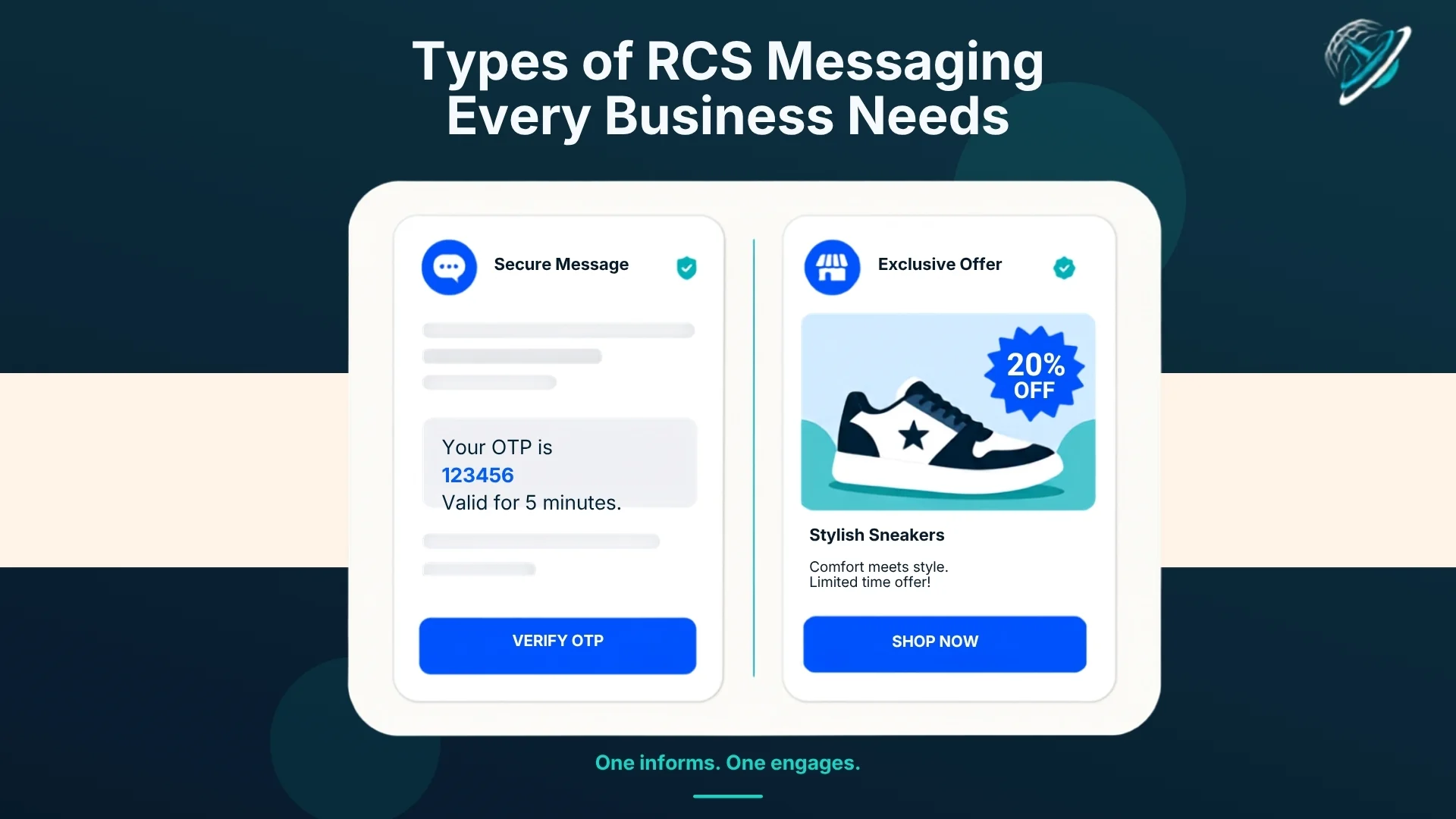
There are two types of RCS messages by intent: transactional, triggered by something the customer did and delivering information they expect, and promotional, initiated by the business to prompt an action.
Both travel over the same Google RCS Business Messaging channel from the same verified sender. Separately, RCS messages are classified by capability into four tiers — basic, single rich card, carousel and conversational. Those are two different classifications, and confusing them is how businesses end up sending a marketing carousel under a transactional consent basis.
The classification rule: transactional = customer acted first + no offer attached. Everything else is promotional.
- Transactional RCS — OTP, payment alert, order confirmation, delivery update, invoice. Consent implied by the transaction. Any hour. No frequency cap. ₹0.16 per message.
- Promotional RCS — offer, launch, product discovery, re-engagement, conversational journey. Explicit marketing consent required. Daytime only. Capped. ₹0.30 per message.
Last verified 2 September 2026.
Which type of RCS message should you send?
- Best for OTPs and login verification: Transactional RCS — verified sender identity, no marketing consent needed, read receipts confirm the code arrived.
- Best for payment alerts and invoices: Transactional RCS — branded sender identity reduces the phishing risk plain SMS carries.
- Best for order and delivery updates: Transactional RCS — the customer initiated the purchase, so the message is expected and rarely reported.
- Best for offers and product launches: Promotional RCS — rich cards and action buttons let a customer explore without leaving the messaging app.
- Best for product discovery: Promotional RCS on the carousel tier — multiple swipeable cards replace a landing-page visit.
- Best for support and lead qualification: Conversational RCS — two-way replies with bot automation and handover to a live agent.
- Two types by intent, four tiers by capability. They are separate choices — an OTP is transactional intent on the basic tier; a launch campaign is promotional intent on the carousel tier.
- Adding an offer changes the category. An order update with a discount code is a promotional message, whatever it is called internally.
- Transactional rests on the transaction. Promotional needs explicit marketing consent, recorded per contact and evidenced on request.
- An opt-out from promotional must not stop transactional. Suppressing both is a service failure; suppressing neither is a compliance failure.
- Transactional messages need mandatory SMS fallback. A promotional message that fails to deliver can reasonably be dropped. An OTP cannot.
- Never report on the two together. A blended read rate hides a problem in both halves.
What is a transactional RCS message?
A transactional RCS message is triggered by something the customer has already done — placing an order, requesting a login code, making a payment — and delivers information they are expecting. It is the message that would still be worth sending if it carried no offer at all.
What it is not: it is not a message that promotes, upsells or cross-sells. Who it is for: any business with an operational trigger, which is why the pattern recurs across banking and finance, logistics, healthcare, travel and ecommerce alike.
OTP and verification
Login codes and account verification, sent with a verified sender identity so the customer can see who the code actually came from. Read receipts confirm it arrived rather than leaving you guessing.
Payment and invoice alerts
Confirmations, reminders and receipts. This is where the verified sender matters most — branded identity is the difference between a payment message and something that reads like a phishing attempt.
Order and delivery updates
Dispatch, out-for-delivery and delivered notifications. The customer initiated the purchase, so these are expected, opened, and almost never reported.
What is a promotional RCS message?
A promotional RCS message is one the business initiates to create interest, demand or a response. Offers, launches, catalogue browsing, re-engagement, and two-way conversational journeys all sit here.
What it is not: it is not a message the customer is waiting for — which is precisely why it needs explicit marketing consent and sits inside time-of-day and frequency norms that transactional messages are exempt from. Who it is for: retail and D2C, real estate, ed-tech, travel, and anyone running acquisition or retention campaigns.
Offers and launches
Campaigns a customer can open and act on inside the messaging app, with the image, the price and the button in one place instead of a link to somewhere else.
Product discovery
Carousels that let a customer swipe through a range. This is the format that genuinely replaces a landing-page visit rather than merely pointing at one.
Support and qualification
Conversational journeys where the customer replies: a bot handles the routine path, a human agent takes over when it stops being routine.
Transactional vs promotional RCS: the full comparison
The two categories differ on eleven practical points. Most teams get the first three right and then treat the rest as interchangeable, which is where the trouble starts.
| Transactional RCS | Promotional RCS | |
|---|---|---|
| Purpose | Deliver information the customer expects. | Create interest and prompt an action. |
| Triggered by | A customer action or system event. | A business decision or campaign schedule. |
| Typical messages | OTP, payment alert, order confirmation, delivery update, invoice. | Offer, launch, catalogue browse, re-engagement, abandoned cart. |
| Consent basis | Implied by the transaction. | Explicit marketing consent required. |
| Timing | Immediate and event-driven, any hour. | Scheduled, inside accepted daytime norms. |
| Frequency | As many as events occur. | Capped — over-sending drives opt-outs. |
| Typical format | Text with verified sender, occasionally one button. | Rich card, carousel, media, multiple buttons. |
| Two-way? | Rarely — a one-way notification. | Often — support, qualification, guided journeys. |
| Risk if miscategorised | Customer misses critical information. | Reported as spam; sender reputation damaged. |
| Primary KPI | Delivery rate, read rate, time to read. | Click-through, reply rate, conversion. |
| Cost basis | Usually the lower per-message tier. | Usually the higher per-message tier. |
Both categories are sent from one verified RCS sender. The separation is operational, not technical.
Are there other types of RCS messages?
Yes, and this is the classification people usually mean when the answer to “how many types” comes back as four instead of two. Transactional versus promotional describes intent. The tiers below describe capability. You choose one from each list, independently.
| Capability tier | What it can do | Usually serves |
|---|---|---|
| Basic RCS | Text, verified sender identity, delivery and read receipts. | Transactional. |
| Single rich card | One image or video, title, description, action buttons. | Either. |
| Carousel | Multiple swipeable cards, each with its own buttons. | Promotional. |
| Conversational | Two-way replies, bot automation, handover to a live agent. | Promotional. |
An OTP is transactional intent on the basic tier. A product launch is promotional intent on the carousel tier.
Which type is the message you are about to send?
A message is transactional only when all three of these hold at once. If any one fails, it is promotional and takes promotional consent, timing and frequency rules with it.
Two out of three is not transactional. The category is decided by the weakest condition, not the strongest.
Adding a discount code to a delivery notification feels efficient — the message was going out anyway. But it converts a message sent under implied consent into one that needs explicit marketing consent, and it is sent to a list that was never asked. That is the single most common way a compliant RCS programme stops being compliant.
The three conditions applied to six real messages
This is the test we run on a client’s existing message set during onboarding. Every row is a message businesses send routinely; the verdict follows from the three conditions above, not from what the message is called internally.
| Message | Customer acted first? | Stands up without an offer? | Withholding harms them? | Verdict |
|---|---|---|---|---|
| Login OTP | Yes. | Yes. | Yes — they cannot log in. | Transactional. |
| Payment failed, retry link | Yes. | Yes. | Yes — the order lapses. | Transactional. |
| Out for delivery today | Yes. | Yes. | Yes — a missed delivery. | Transactional. |
| Delivered, plus 10% off next order | Yes. | No — an offer is attached. | Partly. | Promotional. |
| Abandoned cart reminder | Yes. | No — it exists to sell. | No. | Promotional. |
| Festive sale announcement | No. | No. | No. | Promotional. |
Row four is the one that catches most teams: a genuinely transactional message becomes promotional the moment a discount is added to it.
Choose the type in four questions
Run any message through this before it is scheduled. It resolves in four steps and settles both the intent category and the capability tier.
This is promotional
- Does it need the customer to browse, choose or reply?
- If yes — use a rich card, carousel or conversational tier
- If no — ask whether RCS is adding anything SMS would not
- Confirm explicit marketing consent exists for every recipient
Check for an offer, then decide
- Contains an offer, upsell or cross-sell? It is promotional
- No offer, and time-critical? Basic RCS with mandatory SMS fallback
- No offer, not time-critical? Basic or single rich card
- Either way, keep it out of the promotional frequency cap
Can a business send both types from one sender?
Yes, and most do. A single verified RCS sender identity carries both categories. What has to stay separate is the operational discipline around them — five things, and each one is a real failure mode when it slips.
Do the two types cost the same?
No. RCS is priced per message and the two categories sit on different rate tiers, with promotional above transactional — the same structure the Indian SMS market uses, and a large part of why the RCS versus SMS comparison depends on which category you send most of.
| Message type | What it covers | Rate per message (INR) |
|---|---|---|
| Transactional / utility | OTPs, payment alerts, order and delivery updates, invoices, service notifications. | ₹0.16 |
| Promotional | Rich campaigns, branded promos, offers, product discovery, re-engagement. | ₹0.30 |
Source: Unique Digital Outreach pricing. No setup fee, no subscription. Verified 2 September 2026. Operator rates can move independently of platform fees.
Businesses compare the RCS rate to their SMS rate and stop there. The more useful comparison is against what the message replaces: a promotional carousel that removes a landing-page visit is doing work an SMS never did, while a plain promotional line of text with a link is paying a premium for branding alone. That is a creative decision before it is a channel one.
How we classified these message types
The two-type split follows the intent categories the Indian operator networks and Google’s RCS Business Messaging documentation both use, cross-checked against the transactional and promotional distinction TRAI already applies to SMS. The capability tiers are taken from the message formats Google’s documentation defines. No rates are quoted in this article: RCS operator tiers change independently of platform fees, so pricing is left to the source of record rather than restated here.
- Google, RCS Business Messaging documentation — read 2 September 2026.
- GSMA, RCS Business Messaging — read 2 September 2026.
- Telecom Regulatory Authority of India, commercial communications regulations — read 2 September 2026.
- Unique Digital Outreach, pricing — source of record for current rates.
Last verified 2 September 2026 · reviewed by the Unique Digital Outreach team.
Frequently asked questions
Two, by intent: transactional and promotional. Separately, RCS messages are described by capability tier — basic, single rich card, carousel and conversational. That is a different classification and is the reason the answer is sometimes given as four.
Transactional. It is triggered by a customer login or verification attempt and carries no promotional content. It should also have mandatory SMS fallback, because a verification code that does not arrive is a failed login.
Yes. The moment promotional content is added, the message takes on promotional consent and timing obligations, whatever it is labelled internally. If you want to promote to that customer, send it as a separate message to a consented list.
Yes. Transactional messages rest on the transaction itself. Promotional messages require explicit marketing consent, recorded per contact and available as evidence if challenged.
Yes, and that is their main advantage over SMS. Carousels, suggested replies and action buttons let a customer browse and act inside the messaging app rather than being sent to a website to do it.
The message falls back to SMS. For transactional messages, and OTPs in particular, that fallback should be mandatory rather than optional so a code is never lost to an unsupported handset.
No. RCS is a carrier-delivered upgrade to SMS, supported by Google’s RCS Business Messaging, and it arrives in the phone’s default messaging app. WhatsApp is a separate platform with its own message categories and its own pricing.
RCS is delivered through the operator networks alongside SMS, so sender and template registration obligations apply in a comparable way. Confirm the current position with your provider before launch, as TRAI requirements change.
Transactional. The volume is predictable, the consent basis is straightforward, and it establishes sender reputation before any promotional sending begins. The RCS onboarding guide covers the setup order in detail.