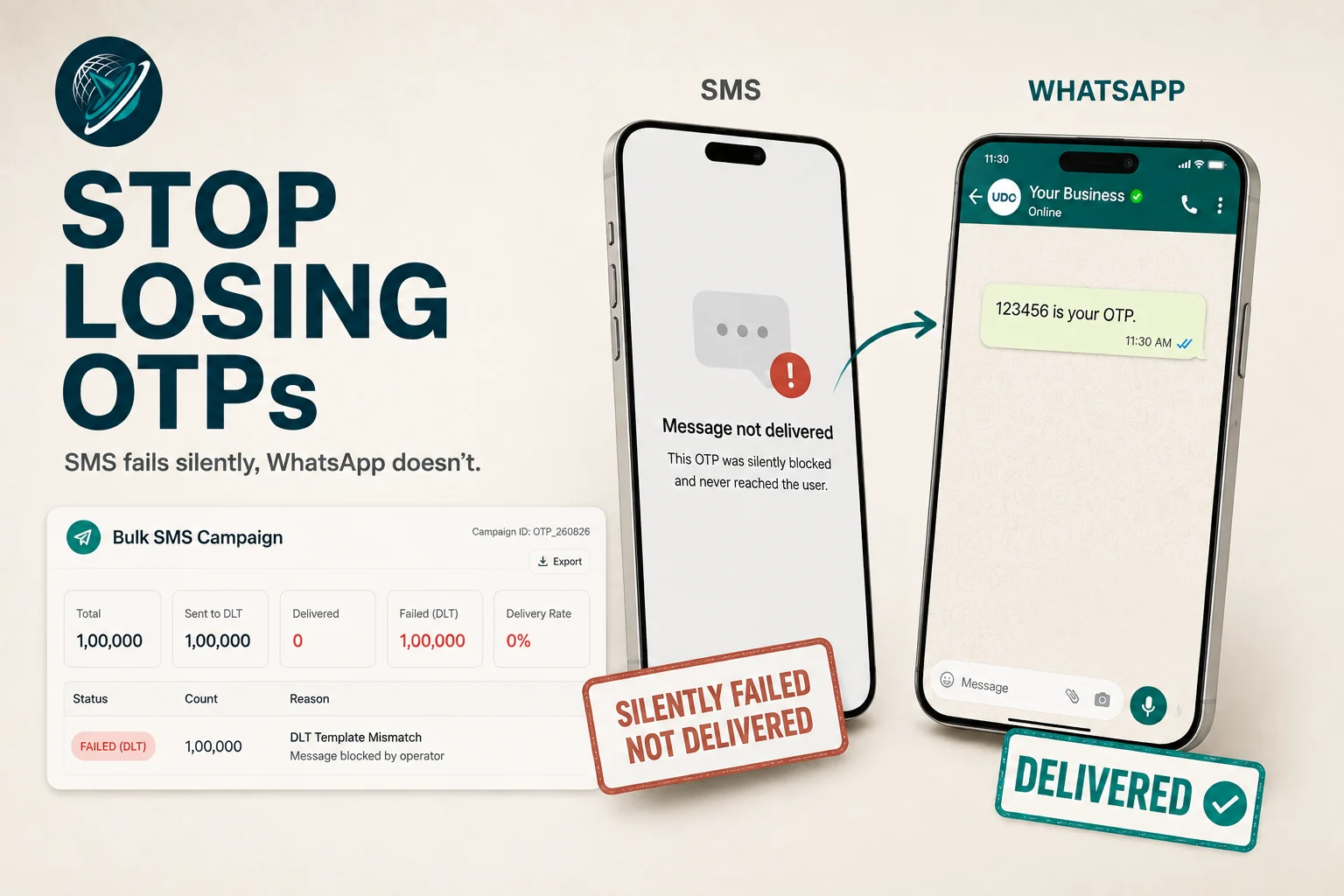
Migration from SMS OTP to WhatsApp OTP means moving one-time passcode delivery off the text-message channel and onto WhatsApp authentication templates, keeping SMS as automatic fallback. Businesses do it because SMS fails in ways they cannot see: in India that message passes through a regulatory scrubbing layer, a carrier queue and a spam-cluttered inbox before it reaches anyone.
Each stage can drop it, delay it or bury it — and your systems will report success anyway.
That gap between what your logs say and what your customer experiences is the whole problem.
Teams discover it not through monitoring but through support tickets, abandoned signups and the app-store review that says "OTP never comes."
This article walks through the seven ways SMS OTP fails in practice, what each one looks like from the customer's side, and exactly what a migration from SMS OTP to WhatsApp OTP changes for your business. We sell both channels, so where SMS is still the right answer, we say so.
Why plan a migration from SMS OTP to WhatsApp OTP?
SMS OTP fails in seven distinct ways, and most businesses see only one of them:
- Silent DLT rejection — one word off template and the operator drops it.
- Latency — 3 to 30+ seconds; a late code never existed.
- Receipts that lie — they confirm the carrier, not the handset.
- Sender spoofing — SMS headers can be imitated. That is how OTP phishing works.
- Bot fraud — pumped traffic you pay for and nobody reads.
- The retry spiral — resend, then a voice call, then a support ticket.
- Reach gaps — DND, roaming, dual-SIM and dead numbers fail silently.
WhatsApp removes the first five outright: no DLT layer, no spoofable sender, no payout for attackers, and device-level receipts.
- Most SMS OTP failures never reach your dashboard. Your real success rate is almost certainly worse than the number you report.
- Delivery receipts measure the wrong event. They confirm the carrier accepted the message, not that a handset received it.
- The failure is invisible to you and obvious to the customer. They see nothing, blame your app, and leave. You see a successful API call.
- DLT is the single biggest cause in India. A rebrand, a shortened link or an extra full stop can silently break every OTP you send until someone notices.
- OTP phishing depends on SMS being impersonable. A verified WhatsApp business profile cannot be faked the way an SMS sender header can.
- Do not switch everything. WhatsApp-first with SMS fallback is the architecture that works, because not every customer is reachable on WhatsApp.
Why does my SMS OTP say delivered but never arrive?
Because India puts a regulatory layer between your provider and the handset that most markets do not have. Under TRAI's DLT framework, every sender ID and every message template must be registered in advance, and the telecom scrubbing layer compares each outgoing message against what you registered.
The comparison is literal. Change a word, add a variable, shorten a URL, update your brand name, insert a full stop — and the message no longer matches.
The operator rejects it at the network edge. Your API returns success. Your logs show sent.
The cruelty of this failure is that it is invisible until volume makes it obvious.
A marketing team updates the product name in a template on Monday; by Wednesday support is drowning and nobody has connected the two events.
What does a DLT template mismatch actually look like?
- A variable renamed in code but not re-registered, so {#var#} no longer lines up.
- A shortened or swapped tracking link inside the message body.
- A brand name updated after a rebrand, in the template but not on the DLT portal.
- An extra space, full stop or emoji added by a copy edit nobody flagged as technical.
- A sender ID reused across entities without being registered against the new one.
How long does DLT approval take to fix?
Re-registering a template typically takes one to two weeks, which is why discovering the mismatch late is so expensive. Every day of that window is a day of failing logins.
DLT approval and template drift are ongoing, not one-time. Teams complete registration at launch, treat it as done, and then break it eighteen months later with a routine copy change. If your OTP template has been edited since it was approved, verify it today — you may already be failing.
An OTP that arrives late has already failed
OTP delivery time in India ranges from under 3 seconds on a direct SMPP connection to over 30 seconds through a reseller chain, and every hop between you and the operator adds latency you cannot see or control.
Thirty seconds does not sound like a failure. It is.
Your OTP screen has a countdown on it, users start tapping resend at around fifteen seconds, and by the time the first code lands the second one has invalidated it. Now the customer has two codes, neither works, and they are certain your app is broken.
This is the failure mode that produces the worst app-store reviews, because from the outside it is indistinguishable from incompetence.
Why does the resend button make it worse?
Because each resend issues a new code and invalidates the previous one. A customer who taps it twice while the first message is still in the carrier queue ends up with three codes, none of which work.
Your delivery reports are measuring the wrong thing
Most SMS delivery receipts confirm that the message was accepted by the carrier, not that it appeared on a handset. The distinction sounds academic until you realise your entire OTP health metric is built on it.
A number that has been recycled, a handset that is off, a subscriber who has churned, a device with a full message store — all of these can produce a positive receipt and no delivered message.
When a provider quotes you a delivery percentage, ask which event they are counting.
Which delivery events should you actually be counting?
- Submitted — your provider accepted the request. Says nothing about delivery.
- Sent — handed to the carrier. Still says nothing about the handset.
- Delivered (carrier DLR) — the carrier claims it went out. This is what most dashboards show.
- Delivered (device) — it reached the phone. This is what you want and rarely get on SMS.
- Verified — the customer entered the code and got in. The only event that matters.
Take fifty real customer numbers that your logs recorded as successful deliveries this week, and call them. Ask whether the OTP arrived and roughly how long it took. Almost every team that runs this exercise finds a gap between reported and actual delivery, and the size of that gap is the real problem you are solving.
Anyone can put your brand name on an SMS
An SMS sender header is a short alphabetic string. It is not an identity, it is not cryptographically bound to you, and in practice it can be imitated. This is the mechanism behind every OTP phishing campaign your customers have ever received: a message that looks exactly like yours, asks for the code that just arrived, and takes the account.
The damage lands on you regardless of fault.
The customer does not distinguish between "my bank was impersonated" and "my bank was breached", and your support team spends the week explaining a message you never sent.
WhatsApp authentication is delivered from a verified business profile with a display name Meta has checked, a profile photo and a business description. It is not impersonation-proof — nothing is — but a fake cannot appear inside the same verified conversation thread the customer already trusts.
How do customers tell a real OTP from a fake one?
On SMS, largely they cannot. The header looks the same, the wording is copied from your real template, and the message sits in the same thread as your genuine ones. That is the entire attack.
Bots are draining OTPs you never sent to a customer
SMS pumping, also called artificially inflated traffic or AIT, works by hammering your send-OTP endpoint with numbers routed through ranges the attacker earns a share of. Every message is legitimate as far as your system knows. None of them reaches a real user.
The scale is documented. One-time passcodes now account for roughly 89% of all international A2P SMS traffic, which makes authentication endpoints the primary target. Prelude's 2025 dataset found that 11.83% of the authentication traffic it analysed was fraudulent. Infobip puts the total drain on businesses at $1.6 billion in 2023, and X has been reported to lose around $60 million a year to it.
WhatsApp removes the incentive rather than the attack. There is no premium-rate revenue share for a fraudster to collect, so pumping your WhatsApp authentication endpoint earns them nothing.
Who is most exposed to OTP bot traffic?
- Any signup or login endpoint that sends an OTP before a captcha or rate limit.
- Products with international phone-number support and no per-country throttling.
- Apps where the resend button has no cooldown.
- Anything where an unauthenticated request can trigger a message.
The retry spiral, and where it ends
No OTP failure stays a single failure. The customer taps resend. That fails too, often for the same unresolved reason.
Many flows then escalate to a voice OTP call, which arrives as an unknown number reading digits aloud — and a large share of Indian users decline unknown calls outright.
At the end of the spiral is a support ticket, and support tickets are where the real damage sits.
The customer has now spent five minutes failing to log in, contacted you about it, and formed a view of your product that a working OTP would never have created.
What does the retry spiral cost you beyond the message?
The message is the cheapest part. What follows is a support contact, an agent's time, and a customer who now associates your product with being locked out.
Where SMS quietly cannot reach at all
Several categories of customer are structurally hard to reach over SMS, and none of them announce themselves in your logs.
- Wrongly-routed traffic. Transactional and promotional routes behave differently against DND registrations. An OTP sent down the wrong route can be filtered before it starts.
- Dual-SIM handsets. The registered number may sit in a slot with no active data or a different primary SIM, so timing and delivery become unpredictable.
- Roaming and international customers. Delivery through unfamiliar operator chains is slower, less reliable and considerably more expensive.
- Recycled and dormant numbers. Indian numbers are reallocated after prolonged inactivity, so an OTP can be delivered successfully to someone who is not your customer.
- Crowded inboxes. On a handset receiving dozens of daily promotional messages, a correctly delivered OTP can still be missed.
How WhatsApp OTP benefits your business
Moving authentication to WhatsApp does not repair SMS. A migration from SMS OTP to WhatsApp OTP removes the stages of the chain where the failures above originate.
| SMS failure | On WhatsApp authentication | What your business gains |
|---|---|---|
| Silent DLT template rejection | Removed. No DLT layer. Meta template approval usually completes in minutes to hours. | A routine copy change can no longer take authentication down for a week before anyone notices. |
| Unpredictable latency | Improved. Delivery is over data, not the carrier SMS queue. | Fewer resend taps and fewer duplicate codes, so more signups finish instead of stalling. |
| Receipts that confirm carrier handoff | Removed. Delivery and read receipts reflect the device. | Your OTP reporting finally matches what the customer actually experienced. |
| Spoofable sender header | Removed. Verified business profile with a checked display name. | Phishing that trades on your brand loses the channel it depends on. |
| SMS pumping and AIT | Removed. No premium-route revenue share for an attacker to earn. | Bot traffic stops draining an authentication budget that never reached a real user. |
| Retry spiral into voice OTP | Reduced. Fewer first-attempt failures, and one-tap autofill removes manual entry. Same behaviour whether you send from our API or a connected CRM. | Fewer "OTP not received" tickets, and less agent time spent on a preventable problem. |
| Reach gaps | Not solved. Customers not on WhatsApp still need SMS. This is why fallback is mandatory. | Nothing. This row is exactly why the SMS fallback stays permanent. |
WhatsApp authentication templates are a fixed format with a copy-code or one-tap autofill button. You cannot send free-form OTP text, which is a constraint worth knowing before you plan the migration.
Does WhatsApp OTP work if the customer has no data?
No. WhatsApp needs an active data connection, and that is precisely the moment SMS still earns its place in your stack. It is the single strongest argument for keeping fallback permanently rather than treating it as a transition step.
What happens to customers who are not on WhatsApp?
They receive the OTP over SMS exactly as they do today, provided you built the fallback. If you did not, they are locked out entirely — which is why the fallback path is built first in the runbook below.
What WhatsApp OTP does not fix
We sell SMS as well as WhatsApp, so there is no version of this where we need you to switch. These are the limits.
How to plan a migration from SMS OTP to WhatsApp OTP
The shape that works is WhatsApp-first with automatic SMS fallback, rolled out in stages. Nobody should move all authentication traffic to a new channel in a single release.
How do you know the migration worked?
- Completed verifications as a share of OTP requests went up, not just delivery rate.
- Median time from request to verification fell.
- Resend rate fell.
- "OTP not received" ticket volume fell.
- Signup completion at the OTP step improved.
Not delivery rate. Track completed verifications as a share of OTP requests — how many people who asked for a code actually got in. It is the only measure that captures every failure mode in this article at once, and it is the one your dashboard almost certainly is not showing you today.
How does UDO make the migration smooth?
Most of the pain in a migration from SMS OTP to WhatsApp OTP is not the sending. It is running two channels, two integrations, two vendors and two invoices while you are halfway between them.
That is the part we removed.
One API, and the channel is just a parameter
This is the change that makes everything else easy. Our REST API takes the mobile number, the channel, the OTP length and the expiry, and returns a response in under 100ms. Moving a request from SMS to WhatsApp means changing one field, not writing a second integration.
Fallback stops being an architecture problem and becomes a conditional. You are not maintaining two codebases that drift apart.
What we take off your plate
Undelivered messages are never charged, on SMS or on WhatsApp. During a migration that matters more than usual, because the entire premise of the exercise is that some of your current sends are not arriving — and you should not be paying for those.
What changes once you are fully migrated?
First, what fully migrated means here. It does not mean SMS is switched off — that would lock out every customer who is not on WhatsApp.
It means WhatsApp is the default path for everyone reachable on it, with SMS running underneath as automatic fallback. That is the steady state, and it is permanent. Once you are there, six things change.
You can finally see what happened
Delivery and read receipts reflect the device, not the carrier. For the first time your OTP reporting describes what the customer actually experienced.
Template drift stops breaking logins
No DLT scrubbing layer on the primary path. A routine copy change can no longer silently take down authentication for a week before anyone notices.
Your brand stops being impersonable
Codes arrive from a verified business profile inside a thread the customer already recognises. The mechanism OTP phishing depends on is gone.
Bot traffic stops paying attackers
There is no premium-rate revenue share to earn, so pumping your authentication endpoint returns nothing to whoever is doing it.
- Fewer support contacts. The largest operational gain, because "OTP not received" is consistently one of the highest-volume ticket categories for Indian consumer apps — and every one of those tickets was preventable.
- One-tap autofill. The customer taps a button instead of memorising six digits, switching apps and typing them back. Fewer entry errors, fewer expiries, faster completion.
- The thread stays useful after login. When a customer replies, a 24-hour service window opens in which you can answer in any format. An authentication channel quietly becomes a support channel.
- Higher completion where it counts most. The OTP screen is the last gate before activation, so recovering failures there converts acquisition spend you have already made into customers you keep.
- One place to look. Authentication across WhatsApp and SMS reports into a single account, so you can watch blended completion instead of reconciling two systems.
- Room to move. With WhatsApp Business API already live for authentication, order updates, reminders and two-way support run on infrastructure you have finished integrating.
You still run DLT for the fallback path, customers without data still need SMS, and a badly designed OTP flow is still badly designed. Migration removes a set of delivery failures. It does not remove the need to keep the SMS leg healthy, and any provider telling you otherwise is selling you something.
Find out what your real OTP failure rate is
Before changing channel, it is worth knowing which of the seven failures is actually hitting you — because if it is a drifted DLT template, that is a same-day fix and no migration is needed. Send us a week of OTP logs and we will tell you which one it is, including when the answer is that your SMS setup is fine.
Frequently asked questions
Most SMS delivery receipts confirm that the carrier accepted the message, not that it reached the handset. In India there is an additional cause: the DLT scrubbing layer compares each message against your registered template and rejects mismatches at the network edge, often without a meaningful error reaching your application. Between those two, a message can be logged as successful and still never appear on anyone's phone.
Template mismatch under the DLT framework. Your sender ID and message templates are registered with the telecom operators, and the scrubbing layer performs a literal comparison against them. A changed word, a new variable, a shortened link, a rebrand or even extra punctuation can cause silent rejection. Because it usually follows a routine copy change rather than a technical one, teams rarely connect the failure to its cause.
It is harder to impersonate. An SMS sender header is a short text string that can be imitated, which is the mechanism behind OTP phishing campaigns. WhatsApp authentication arrives from a verified business profile with a display name Meta has checked, inside a conversation thread the customer already recognises. It does not stop social engineering, though. A customer persuaded to read their code aloud is compromised on any channel.
SMS pumping, or artificially inflated traffic, is automated abuse of your send-OTP endpoint to generate messages to number ranges the attacker earns revenue from. One-time passcodes are roughly 89% of international A2P SMS traffic, making authentication the main target, and one 2025 dataset found 11.83% of analysed authentication traffic was fraudulent. Exposure is highest on international traffic, so businesses sending OTPs abroad are affected far more than purely domestic ones.
Under three seconds is achievable on a direct SMPP connection, while reseller chains can take more than thirty. The practical threshold is set by your own interface: users typically begin tapping resend around fifteen seconds, and once a second code is issued the first is invalidated. If your OTP screen has a countdown, your real delivery deadline is that countdown, not any figure in a provider's marketing material.
No. WhatsApp-only authentication locks out every customer who is not on WhatsApp, which in India includes feature-phone users, low-connectivity areas and a meaningful share of older and rural customers. The architecture that works is WhatsApp-first with automatic SMS fallback triggered by delivery failure or timeout. Treat this as adding a channel, not retiring one, and keep your DLT registration current for the fallback path, with both channels on one account.
Yes, because SMS stays as your fallback. Every customer not reachable on WhatsApp still receives their code over SMS, and TRAI's DLT framework applies to that traffic no matter what your primary channel is. Your sender ID and OTP templates must remain registered and match exactly what you send. WhatsApp is governed separately by Meta's own template approval process and does not use DLT.
Stop measuring delivery and start measuring completion. Track the share of OTP requests that end in a successful verification, which captures every failure mode at once rather than only the ones your provider reports. Then take fifty numbers your logs recorded as delivered this week and contact those customers to ask whether the code arrived and how long it took. The gap between those two figures is your real problem.
How often does your OTP actually arrive?
Every OTP that silently fails is a signup abandoned, a login blocked and a support ticket you did not need. Start by finding out how often it happens — the fix is frequently smaller than the migration.