RCS for transport & logistics
RCS for logistics: every status change, delivered before anyone asks.
Every shipment status your systems record can reach the recipient as an RCS card, with a tracking button, a delivery code and reschedule options built in, triggered from your TMS or WMS over our API. UDO sends each card under your verified name and falls back to SMS for any handset without RCS.
Triggered by REST API · Receipts and taps by webhook · 98%+ delivery
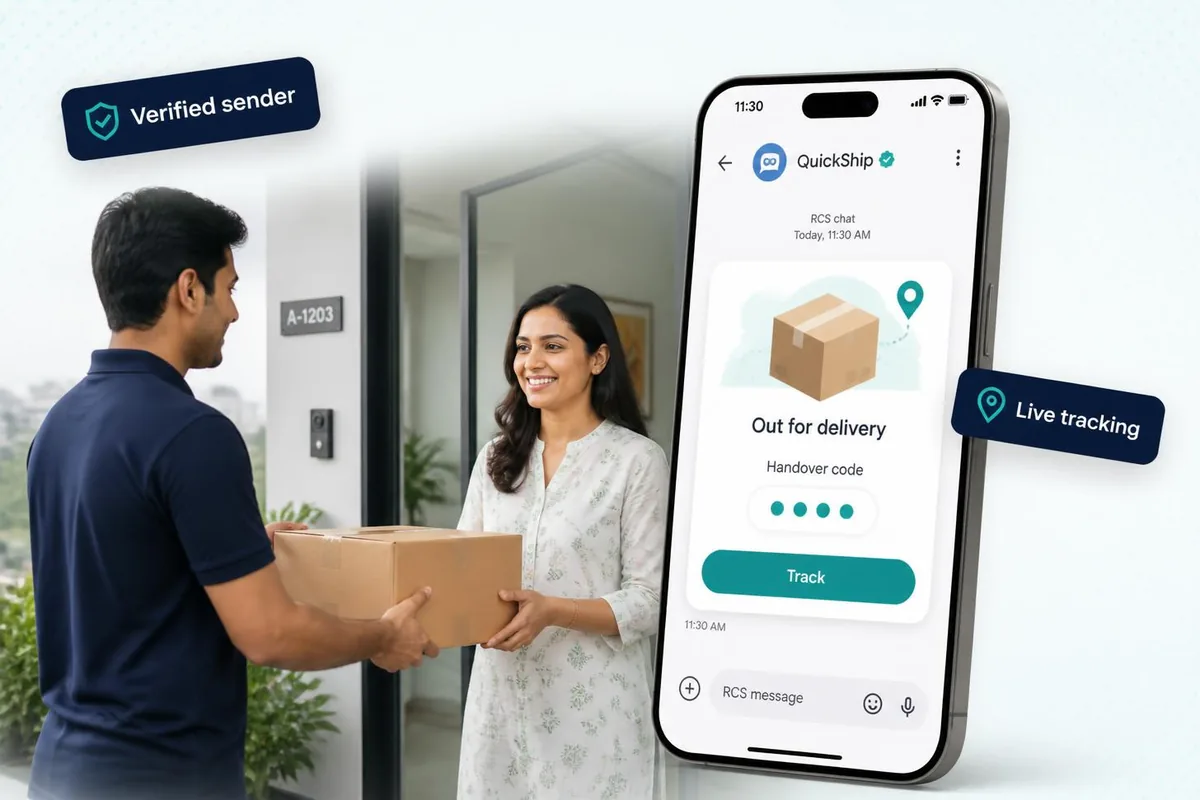
Architecture
How should RCS delivery tracking notifications be built?
Build them event-driven: each status change in your TMS, WMS or order system calls a messaging API with a pre-approved card and the shipment's details, and delivery and tap events come back by webhook. Whether a recipient gets RCS or SMS is decided per handset at send time, so your system sends one request either way.
Status event
Picked up, in transit, out for delivery, delivered, failed.
One API call
Template, recipient and variables such as AWB and ETA.
Capability check
RCS where the handset supports it, SMS where it does not (how RCS fallback works).
Fallback ready
A DLT template and a whitelisted tracking link.
Events back
Delivered, read and button taps, by webhook.
Keep each shipment's updates in order, and have your system drop a stale update rather than send it late: "out for delivery" arriving after "delivered" does more harm than silence. And keep tracking links on a domain that is on your DLT whitelist, or the SMS version is blocked. Google Messages puts RCS on roughly 95% of Indian Android handsets, and Apple added RCS support in iOS 18, though iPhone reach is not yet universal, so the SMS fallback has to work for everyone the card cannot reach. The API documentation covers webhooks and callbacks.
Card examples
RCS order confirmation, delivery day and the failed attempt.
The three cards most carriers and stores send first. Each answers the question the recipient would otherwise phone in.
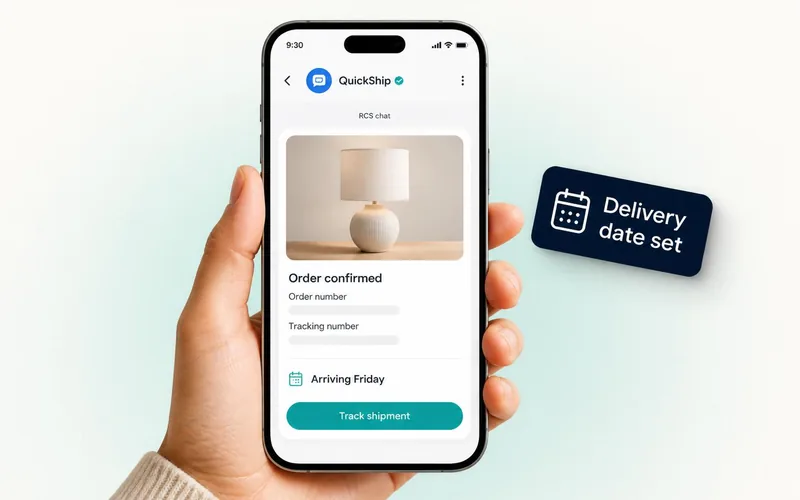
Order confirmation with tracking
A product image, the order and tracking numbers, the expected date and a "Track shipment" button. Sent when the label is created, it heads off the first "where is my order" call.
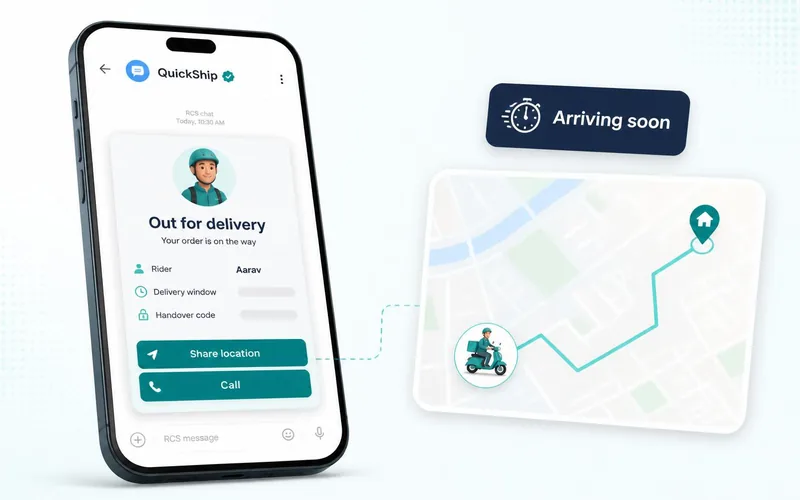
Out for delivery, with a handover code
The delivery window, the rider's first name and the handover code to give at the door. "Share location" sends a precise pin for gated societies and unmarked addresses.
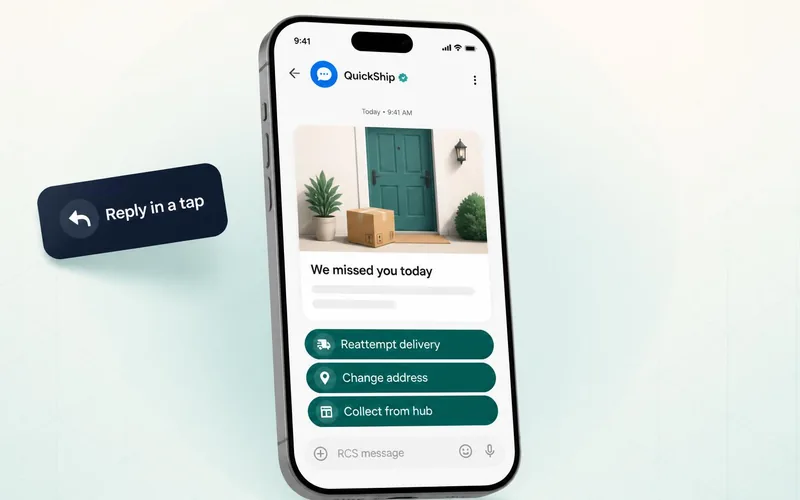
Failed attempt, fixed in a tap
The card says why the delivery failed and offers the fixes: reattempt, change address or collect from the hub. The reply updates your non-delivery report before the next run, instead of becoming a return to origin.
Freight and B2B
Shippers want milestones, not marketing.
Milestone updates for both ends of a consignment
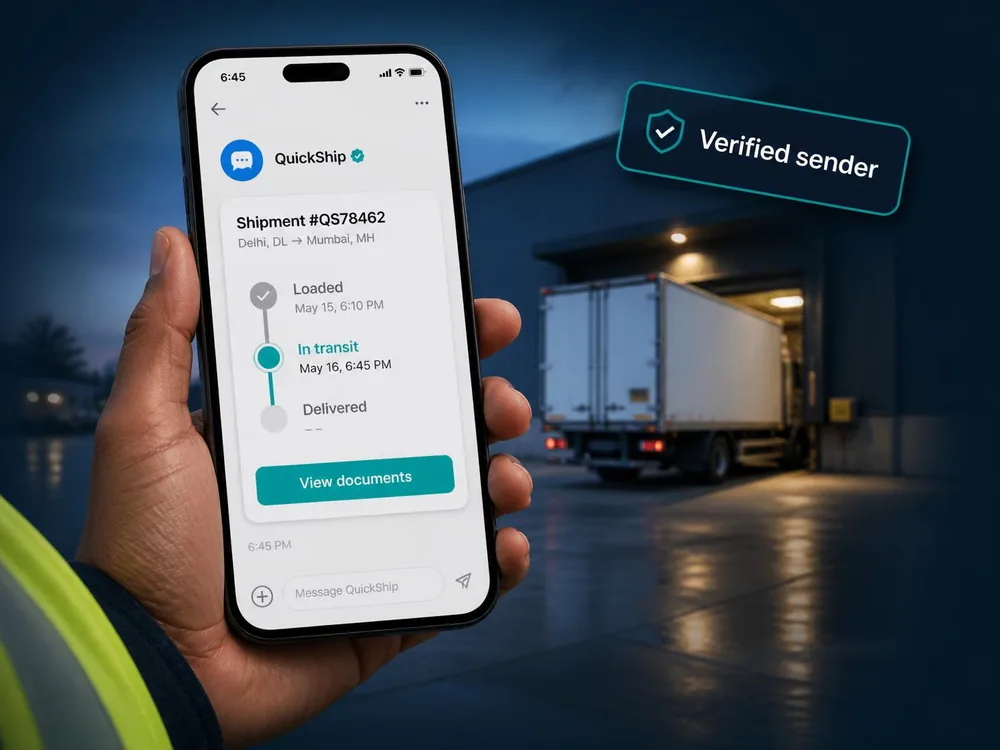
A business customer follows a consignment through pickup, linehaul, hub transfers and delivery, and each milestone matters to the consignor and the consignee. One card per milestone carries the consignment note number, the vehicle and the next expected event, with the paperwork a button away.
- E-way bill and consignment note behind a "View documents" button
- Proof of delivery as a photograph and timestamp, sent to the consignor
- Delay alerts with a reason and a revised estimate, before the customer notices
- Read receipts that show the receiving warehouse saw the arrival notice
Moving people
Passenger transport runs on the same cards.
Bus operators, cab fleets and shuttle services send the same kind of status message, to a passenger instead of a parcel. For pickups and itinerary changes, see messaging for travel operators.
Booking and boarding
Ticket details, seat and the boarding point as a map pin, with "Get directions" to the right bay.
Delays and changes
A revised departure with the reason, and the passenger's options offered as suggested replies.
Trip complete
An invoice button and a one-tap rating while the journey is still fresh.
Who sends it
RCS for logistics, from the courier counter to the freight yard.
For every channel a logistics business runs, see messaging for logistics and transportation.
Courier and express
Pickup confirmations, delivery codes and failed-attempt recovery at parcel volumes.
Last-mile fleets
Rider arrival windows and location sharing for addresses a map does not know.
Warehousing and 3PL
Dock slot bookings, arrival notices for incoming stock and dispatch confirmations to the brand.
Trucking and freight
Milestone and delay updates to consignors and consignees, documents attached.
Questions
Frequently asked.
In logistics, RCS means Rich Communication Services: shipment updates sent as verified, branded cards with tracking buttons, delivery codes and reply options, inside the recipient's default messaging app.
Carriers use it so recipients act on an update instead of phoning about it. The standard is explained here.
Register a rich-card template with a product image, the order variables and a "Track shipment" button, then trigger it from your system through our REST API when the label is created.
The SMS version of the same template, with a whitelisted link, goes to phones that cannot receive RCS.
In air-cargo tracking, RCS is a status code meaning the consignment has been received from the shipper and accepted for carriage.
It is unrelated to Rich Communication Services, the messaging standard this page covers, though a carrier can send an RCS message when that status appears.
Yes. Suggested replies such as "Reattempt delivery" or "Change address" return to your system as structured answers, and "Share location" sends a map pin.
Typed replies can be passed to your support team through the same webhook.
Yes, through our REST API, with webhooks for delivery, read and reply events. Any system that can make an HTTP call on a status change can trigger a card.
The API documentation lists the endpoints.
The SMS fallback does: each fallback message needs a DLT-registered header and template, and any tracking link in it must be on your registered whitelist.
The RCS card itself goes out under a sender Google has verified.
Answer "where is my order" before it is asked.
Share the status events your system already records. We will map each one to an RCS card and its SMS fallback, ready to trigger from your TMS.